EIFELRUNDFAHRT
Nideggen (D), 19 July 1924 (Saturday).
6 x 33.2 km (13.86 mi) = 199.2 km (123.8 mi)
10 x 33.2 km = 332.0 km (206.3 mi)
12 x 33.2 km = 398.4 km (247.6 mi)
15 x 33.2 km = 498.0 km (309.4 mi)
| No. | Driver | Entrant | Car | Type | Engine |
|
| Touring cars Class I - up to 4 hp - 6 laps |
| 16 | Heinz August Flacke | Essen | Amilcar | 4/11PS | 1.1 | S-4 |
| Konrad Mederer | Köln | Opel | Laubfrosch | 1.0 | S-4 |
| 17 | F. Wüllenhütter | Köln | Amor | 4/16PS | 1.1 | S-4 |
| 18 | Otto Müller | Köln | Amor | 4/16PS | 1.1 | S-4 |
| 19 | Werner Lefrère | Köln | Amor | 4/16PS | 1.1 | S-4 |
| Paul Bauer | Köln | Amilcar | CGS | 1.1 | S-4 |
| Karl Zerenze | Berlin | Pluto | 4/20PS | 1.1 | S-4 |
| |
| Touring cars Class VI - over 10 hp up to 12 hp - 10 laps |
| Fritz Rapp | Köln | Oakland | | 2.6 | S-6 |
| Christian Schlömer | Obergartzem | Peugeot | | 3.0 | S-6 |
| Dr. Hans Ulrich-Kerwer | Bonn | Oakland | | 2.6 | S-6 |
| |
| Touring cars Class VII - over 12 hp - 10 laps |
| 81 | Peter Schleuer | Köln | Benz | 16/50PS | 4.2 | S-6 |
| Heinrich Grathwohl | Köln | Mercedes | 16/45PS | 4.2 | S-6 |
| 78 | Carl Jörns | Rüsselsheim | Opel | 15PS | 3.9 | S-6 |
| Paul Jessen | Köln | Jewett | | 6.3 | S-6 |
| Emil Schulz | Essen | Mercedes | 28PS |
| Theodor Prinz | Köln | Voisin | | | | DNA - Did not appear |
| |
| Racecar Class II - 1101 - 1500 cc - 12 laps |
| 2 | Rudolf Caracciola | Dresden | Mercedes | 6/25/40 s/c | 1.5 | S-4 |
| 18 | Alfred Noll | Düsseldorf | Bugatti | Rabag | 1.5 | S-4
| | 33 | Eugen Prinz | Köln | Citroën | Type-A | 1.3 | S-4 |
| 1 | Karl Koch | Erfurt | Koco | 5/25PS | 1.3 | S-2 |
| |
| Racecar Class III - 1501 - 2000 cc - 12 laps |
| 50 | Josef Jacobs | Berlin | Fafnir | 8/22PS | 1.9 | S-4 |
| 51 | Herbert Utermöhle | Aachen | Fafnir | 8/22PS | 1.9 | S-4 |
| Gustav Münz | Düren | Bianchi | 14/20HP | 2.0 | S-4 |
| |
| Racecar Class IV - over 2000 cc - 15 laps |
| 8 | Willi Cleer | Stettin | Stöwer | | 3.4 | S-6 |
| 10 | Kurt Volkhart | Freiburg | Steiger | 12/50PS | 2.6 | S-4 |
| 5 | Oscar Camminesci | Zetthun | Mercedes |
| 7 | Hans von Opel | Rüsselsheim | Opel | | 3.0 | S-6 |
| Heinrich Schryen | Lindern | NAG | C4b | 2.5 | S-4 |
Caracciola fastest at Eifelrundfahrt
by Hans Etzrodt
The 1924 Eifelrundfahrt for motorcycles, touring- and racecars was held over three days, from Thursday till Saturday. It was considered Germany's most important race of the year. This report limits
itself only to the race on Saturday, when 12 racecars were running simultaneously with 17 touring cars. After five laps Caracciola (1500 Mercedes) was leading Jörns (Opel) by 32 minutes, closely
followed by Noll (1500 Bugatti), Schleuer (4200 Benz), Rapp (2600 Oakland) and Utermöhle (1900 Fafnir) representing the six fastest drivers.
At the end of the race Caracciola won at 72.8 km/h average speed, ahead of Noll (1500 Bugatti) 65.6 km/h, Schleuer (4200 Benz) 63.8 km/h, Cleer (3400 Stöwer) 62.1 km/h, Eugen Prinz (1300 Citroën),
61.35 km/h, and Rapp (2600 Oakland) 57.5 km/h, listing here just the six fastest drivers followed by the remaining 9 finishers.
|
|
The Eifelrundfahrt at Nideggen was first held in 1922, and the 1924 event was the second running. The official name was Eifel-Rundfahrt, which changed in 1924 to Eifelrundfahrt and to Eifel-Rennen in
1925. The ADAC organized the races to win the German Tourist Trophy including three prizes for each class. The circuit remained the same since 1922 with the start at Nideggen, leading clockwise through
the towns of Berg, Wollersheim and Vlatten, then continuing through Heimbach, Schmidt and Brück from where it was just 2 km to Nideggen, completing the 33.2 km lap. The undulating mountain course with
80 turns was also referred to as 'The German Targa Florio'. The Eifelrundfahrt 1924 was held over three days from Thursday 17. July to Saturday 10. July with races for motorcycles, touring- and
racecars. The motorcycles raced on the first day. On the second day, 18. July, the touring cars of class 2 and 5 were started in half-minute intervals. During the rain on the first lap
Caracciola (1500 Mercedes) hit a tree but could continue, only to retire on the second lap with brake and steering problems. This report limits itself to the racecar event, held on Saturday,
19. July, which included touring car classes I, VI and VII and the racecars were split also into three classes, a total of 28 cars.
|
Entries:
The 15 touring cars of class 1, 6 and 7 and 12 racecars are itemized on the list of Entries at the beginning of this report. Voisin driver Theodor Prinz (Touring cars Class VII over 12 hp) did not appear.
Caracciola received support from the Dresden Mercedes Dealership providing the car. On the second day he raced amongst the touring cars but retired with brake- and steering problems. After the repair the
car was stripped of fenders, running boards and lights, ready for Caracciola to start in the 1500cc racecar class. Karl Koch (Koco) had to start in the racecar class since his car was too light for a
touring car. For the three 1100cc Amor touring cars, Köln was given as town of origin, but looking at the cars one could recognize the French original Peugeot. The Pluto driver Zerenze (touring car
class I up to 4 hp) was also listed as "Geretzschke" by Aachener Anzeiger.
|
Race:
After two bad rainy days, on the third day, Saturday, 19. July, sunshine changed with rain showers. At the start in Nideggen 12 racecars lined up together with 15 touring cars of class 1, 6 and 7.
The first car, Flacke (Amilcar) started at 6:27 a.m. followed by the other cars of the small touring car class, soon after followed Caracciola (Mercedes) of the 1500cc racecar class, also Schleuer (Benz)
of the largest Touring car class, then Noll (Bugatti) of the 1500cc racecar class, then Jõrns (Opel) of the largest Touring car class.
At the end of the first lap at the finishing turn in Nideggen Flacke (Amilcar) was first 30 minutes after his start. He was followed surprisingly by Caracciola, who already had passed 12 cars on
the first lap, next was Schleuer (Benz), followed by Jörns (Opel) and Volkart (Steiger) then Noll (Bugatti), Schlömer (Peugeot) and Bauer (Amilcar). But five cars were missing,
Hans von Opel (Opel) and Koch (Koco), both appeared later. The other missing cars were Münz (Bianchi)
and Schryen (NAG) and Zerenze (Pluto).
After the second lap at 7:27 a,m. Caracciola was in the lead increasing his advantage in the next laps. Camminesci (Mercedes) started with problems and gave up on the second lap.
On the third lap Volkhart (Steiger), the second fastest driver, did not make the turn at Tanzley and crashed into a large rock. The front axle and/steering were seriously damaged, but the crowd
pushed him to carry on. Likewise, Emil Schulz also crashed his Mercedes on a rock, but he was out of the race.
On the fourth lap it began to rain slowly while Caracciola (Mercedes) and Utermöhle (Fafnier) passed the starting area. Caracciola drove a wild race. When he passed the Tanzley turn for the fifth
time at 8:52 a.m., he finished the lap in 28 minutes.
After five laps Caracciola held the lead of the 22-car field with the order as follows:
| 1. | Caracciola (Mercedes) | 2h15m59s | racecar 1500 cc |
| 2. | Jörns (Opel) | 2h33m05s | touring car over 12PS |
| 3. | Noll (Bugatti) | 2h33m31s | racecar 1500 cc |
| 4. | Schleuer (Benz) | 2h33m32s | touring car over 12PS |
| 5. | Rapp (Oakland) | 2h34m37s | touring car up to 12PS |
| 6. | Utermöhle (Fafnir) | 2h35m55s | racecar 2000 cc |
| 7. | Schlömer (Peugeot) | 2h35m58s | touring car up to 12PS |
| 8. | Flacke (Amilcar) | 2h39m52s | touring car up to 4PS |
| 9. | Prinz (Citroën) | 2h58m28s | racecar 1500 cc |
| 10. | Cleer (Stöwer) | 2h58m53s | racecar over 2000 cc |
| 11. | Dr. Ulrich-Kerwer (Oakland) | | touring car up to 12PS |
| 12. | Grathwohl (Mercedes) | | touring car over 12PS |
| 13. | Jessner (Jewett) | | touring car over 12PS |
| 14. | Bauer (Amilcar) | | touring car up to 4PS |
| 15. | Wüllenhütter (Amor) | | touring car up to 4PS |
| 16. | Mederer (Opel) | | touring car up to 4PS |
| 17. | Lefrére (Amor) | | touring car up to 4PS |
| 18. | Müller (Amor) | | touring car up to 4PS |
| 19. | Jacobs (Fafnir) | | racecar 2000 cc |
| 20. | Volkart (Steiger) | | racecar over 2000 cc |
| 21. | H. v. Opel (Opel) | | racecar over 2000 cc |
| 22. | Koch (Koco) | | racecar 1500 cc |
| 23. | Emil Schulz | compl. 2 laps | touring car over 12PS |
| 24. | Camminesci (Mercedes) | compl. 1 lap | racecar over 2000 cc |
| 25. | Zerenze (Pluto) | retired lap 1 | touring car up to 4PS |
| 26. | Münz (Bianchi) | retired lap 1 | racecar 2000 cc |
| 27. | Schryen (NAG) | retired lap 1 | racecar over 2000 cc |
The sixth lap Caracciola completed in 25m45s, a new lap record. The small cars finished their race after six laps. Flacke (Amilcar) won ahead of Mederer (Opel). In the 2000cc racecar class started
two Fafnir and a Bianchi which disappeared very soon. Utermöhle (Fafnir) disappeared after the sixth lap while Jacobs (Fafnir) had a very wild driving style. After a collision with a tree, the chassis
was damaged. With the help of a tree trunk and a rope rapped around the riding mechanic, Jacobs was the only one in his class to finish.
At 12:03 Caracciola crossed the finish line amid loud jubilation of the crowd. Despite the danger, the course filled with people. The winner was carried on the shoulders of his followers to the
finishing turn. In the meantime, the race kept going. About half an hour later Noll (Bugatti) finished second but had already been lapped by Caracciola on the eleventh round. One hour later came
Prinz (Citroën) in third place after he faced tire damage on the second round. On lap six he spun the car in a turn into a tree, suffered a forehead wound from a broken steering wheel and replaced
one twisted rear wheel. When Prinz reached the Nideggen repair depot, the steering wheel was changed and after a refreshment drink, he drove the remaining four laps. Koch (Koco) in the same category
crashed, lost two hours and was not able to finish the race within the allowable time.
At 1 p.m. the interest of the spectators slowly subsided. The fourth racecar class covered 15 laps and was won by Cleer (Stöwer) after 8h04m22s. Volkhart in the same class had spent 1½ hours to
straighten with his mechanic the bent front axle at a blacksmith place before rejoining the race after this large time loss. Volkhart drove again very wild, reducing his time loss, and made the
second-best lap of the day in 26 Minutes. He drove several more laps to the enthusiasm of the large crowd. and for this reason, he was assigned the second prize, without him even being able to
complete the race within the allowable time.
At around 2 p.m. an official final car indicated the end of the 1924 Eifelrundfahrt. Saturday evening a celebration was held at the Castle Nideggen for all participants. On Sunday the ADAC ended
the 1924 Eifelrundfahrt with a victory celebration at the Zoo in Köln (Cologne). Caracciola received a challenge trophy donated by the Prinz Company for driving regular and fast laps.
|
Results Touring cars Class I -up to 4 hp
| Pos. | No. | Driver | Entrant | Car | Type | Engine | Laps | Time/Status | Diff |
|
| 1. | 16 | Heinz August Flacke | Essen | Amilcar | 4/11PS | 1.1 | S-4 | 6 | 3h11m09s | 62.5 km/h (38.9 mph) |
| 2. | | Konrad Mederer | Köln | Opel | Laubfrosch | 1.0 | S-4 | 6 | 3h55m33s | + 44m24s |
| 3. | 17 | F. Wüllenhütter | Köln | Amor | 4/16PS | 1.1 | S-4 | 6 | 4h05m51s | + 54m42s |
| 4. | 18 | Otto Müller | Köln | Amor | 4/16PS | 1.1 | S-4 | 6 | 4h20m58s | + 1h09m49s |
| 5. | 19 | Werner Lefrère | Köln | Amor | 4/16PS | 1.1 | S-4 | 6 | 4h43m38s | + 1h32m29s |
| DNF | | Paul Bauer | Köln | Amilcar | CGS | 1.1 | S-4 | 5 | | |
| DNF | | Karl Zerenze | Berlin | Pluto | 4/20PS | 1.1 | S-4 | 0 | | |
| |
| Results Touring cars Class VI - over 10 hp up to 12 hp |
| |
| 1. | | Fritz Rapp | Köln | Oakland | | 2.6 | S-6 | 10 | 5h46m15s | 57.5 km/h (35.7 mph) |
| 2. | | Christian Schlömer | Obergartzem | Peugeot | | 3.0 | S-6 | 10 | 6h02m20s | + 16m05s |
| 3. | | Dr. Hans Ulrich-Kerwer | Bonn | Oakland | | 2.6 | S-6 | 10 | 6h06m11s | + 19m56s |
| |
| Results Touring cars Class VII - over 12 hp |
| |
| 1. | 81 | Peter Schleuer | Köln | Benz | 16/50PS | 4.2 | S-6 | 10 | 5h12m08s | 63.8 km/h (39.7 mph) |
| 2. | | Heinrich Grathwohl | Köln | Mercedes | 16/45PS | 4.2 | S-6 | 10 | 6h28m44s | + 1h16m36s |
| DNF | 78 | Carl Jörns | Rüsselsheim | Opel | 15PS | 3.9 | S-6 | 9 | | |
| DNF | | Paul Jessen | Köln | Jewett | | 6.3 | S-6 | 7 | differential |
| DNF | | Emil Schulz | Essen | Mercedes | 28PS | | S-6 | 2 | | |
| |
| Results Racecar Class II - 1101 - 1500 cc |
| |
| 1. | 2 | Rudolf Caracciola | Dresden | Mercedes | 6/25/40 s/c | 1.5 | S-4 | 12 | 5h27m50s | 72.9 km/h (45.3 mph) |
| 2. | 12 | Alfred Noll | Düsseldorf | Bugatti | Rabag | 1.5 | S-4 | 12 | 6h04m01s | + 36m11s |
| 3. | 33 | Eugen Prinz | Köln | Citroën | Type-A | 1.3 | S-4 | 12 | 6h29m36s | + 1h01m46s |
| DNF | 1 | Karl Koch | Erfurt | Koco | 5/25PS | 1.3 | S-2 | 5 |
| |
| Results Racecar Class III - 1501 - 2000 cc |
| |
| 1. | 50 | Josef Jacobs | Berlin | Fafnir | 8/22PS | 1.9 | S-4 | 12 | 8h04m40s | 49.3 km/h (30.6 mph) |
| DNF | 51 | Hebert Utermöhle | Aachen | Fafnir | 8/22PS | 1.9 | S-4 | 6 |
| DNF | | Gustav Münz | Düren | Bianchi | 14/20PS | 2.0 | S-4 | 0 |
| |
| Results Racecar Class IV - over 2000 cc |
| |
| 1. | 8 | Willi Cleer | Stettin | Stöwer | | 3.4 | S-6 | 15 | 8h00m40s | 62.2 km/h (38.6 mph) |
| 2. | 10 | Kurt Volkhart | Freiburg | Steiger | 12/50 | 2.6 | S-4 | 14 |
| DNF | 7 | Hans von Opel | Rüsselsheim | Opel | 3-L | 3.0 | S-6 | 5 |
| DNF | 5 | Oscar Camminesci | Zetthun | Mercedes | | | | 1 |
| DNF | | Heinrich Schryen | Lindern | NAG | C4b | 2.5 | S-4 | 0 |
| |
Fastest lap: Rudolf Caracciola (Mercedes) on lap 6 in 25m45s = 77.4 km/h (48.1 mph).
Weather: intermittent rain.
|
|
|
In retrospect:
The final times listed in the results were published by the ADAC Der Motorfahrer while Aachener Anzeiger and Kölnische Zeitung published different times. The latter wrote that near evening race
management made the victory list known. (All times of this list added between 3m32s to 3m42s.)
Race numbers listed in the report were obtained from photographs. Neither the ADAC nor any other sources published race numbers in their reports. The spectators probably followed the race with a
program that showed the race numbers. After publishing this report, we learned that the Düsseldorf 'Der Mittag" printed some race numbers in their report, which we added to these pages.
Although the race was held to determine the fastest driver, the timekeepers were not able to always deliver the correct speeds attained. We calculated the speeds afterwards.
|
Primary sources researched for this article:
Aachener Anzeiger, Aachen
ADAC - Der Motorfahrer, München
Allgemeine Automobil-Zeitung, Berlin
Allgemeine Automobil-Zeitung, Wien
Automobil-Welt, Berlin
Deutsche Allgemeine Zeitung, Berlin
KölnerAutomobilmarkt, Köln
Kölnische Zeitung, Köln
Mittag, Düsseldorf
Special thanks to:
Marco Kieser
Hugo Boecker
Reinhard Windeler
|
|
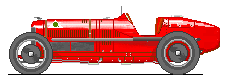
10 Giuseppe Campari
SA Italiana Ing. Nicola Romeo
Alfa Romeo P2 |
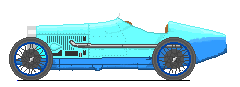
2 Albert Divo
Automobiles Delage
Delage 2LCV |
9 Robert Benoist
Automobiles Delage
Delage 2LCV
|
GRAND PRIX D'EUROPE
Lyon (FRA), 3 August 1924.
35 laps x 23.145 km (14.382 mi) = 810.1 km (503.4 mi)
| No. | Driver | Entrant | Car | Type | Engine |
|
| 1 | Henry Segrave - mec. Maroccchi | Sunbeam Motor Car Co Ltd | Sunbeam | DA8420 | 2.0 | S-6 |
| 2 | Albert Divo - mec. Fretet | Automobiles Delage | Delage | 2LCV | 2.0 | V-12 |
| 3 | Antonio Ascari - mec. Ramponi | SA Italiana Ing. Nicola Romeo & C | Alfa Romeo | P2 | 2.0 | S-8 |
| 4 | Giulio Foresti - mec. Janin | Schmid Automobiles | Rolland-Pilain | Schmid | 2.0 | S-6 | DNS - Did not start |
| 5 | Felice Nazzaro - mec.Carignano | Fiat SpA | Fiat | 805 | 2.0 | S-8 |
| 6 | Louis Zborowski - mec. Davis | Count L. Zborowski | Miller Special | 122 | 2.0 | S-8 | Independent entry |
| 7 | Jean Chassagne - mec. Epting | Automobiles Ettore Bugatti | Bugatti | T35 | 2.0 | S-8 |
| 8 | Kenelm Lee Guinness - mec. Perkins | Sunbeam Motor Car Co Ltd | Sunbeam | DA8667 | 2.0 | S-6 |
| 9 | Robert Benoist - mec. Carra | Automobiles Delage | Delage | 2LCV | 2.0 | V-12 |
| 10 | Giuseppe Campari - mc.Marinoni | SA Italiana Ing. Nicola Romeo & C | Alfa Romeo | P2 | 2.0 | S-8 |
| 11 | Jules Goux - mec.Schoenenberger | Schmid Automobiles | Rolland-Pilain | Schmid | 2.0 | S-6 |
| 12 | Pietro Bordino - mec. Buno | Fiat SpA | Fiat | 805 | 2.0 | S-8 |
| 13 | Ernst Fridrich - mec.Rothfrisch | Automobiles Ettore Bugatti | Bugatti | T35 | 2.0 | S-8 |
| 14 | Dario Resta - mec. Ledu | Sunbeam Motor Car Co Ltd | Sunbeam | DA8666 | 2.0 | S-6 |
| 15 | René Thomas - mec. Lhermitte | Automobiles Delage | Delage | 2LCV | 2.0 | V-12 |
| 16 | Louis Wagner - mec. Sozzi | SA Italiana Ing. Nicola Romeo & C | Alfa Romeo | P2 | 2.0 | S-8 |
| 17 | Giuseppe Pastore - mec. Manzo | Fiat SpA | Fiat | 805 | 2.0 | S-8 |
| 18 | Pierre de Vizcaya - mec. Etienne | Automobiles Ettore Bugatti | Bugatti | T35 | 2.0 | S-8 |
| 19 | Enzo Ferrari - mec. Boninsegna | SA Italiana Ing. Nicola Romeo & C | Alfa Romeo | P2 | 2.0 | S-8 | DNS - Did not start |
| 20 | Onesimo Marchisio - mc.Lorenzo | Fiat SpA | Fiat | 805 | 2.0 | S-8 |
| 21 | Leoncio Garnier - mec. Zirne | Automobiles Ettore Bugatti | Bugatti | T35 | 2.0 | S-8 |
| 22 | Meo Costantini - mec. Zendrini | Automobiles Ettore Bugatti | Bugatti | T35 | 2.0 | S-8 |
Campari wins the European Grand Prix with Alfa Romeo
by Hans Etzrodt
|
The European Grand Prix took place for the second time in 1924, on French soil over 35 laps on the Lyon circuit which was slightly shortened since last used ten years earlier. It was the
greatest assembly of twenty 2-Liter racecars from France, England and Italy which fought for the victory but Germany was not invited. Segrave (Sunbeam) held the lead for the first two laps,
Bordino (Fiat) led on lap three and Ascari (Alfa Romeo) on the fifth lap. The battle was intense amongst the fastest cars, all supercharged. Bordino regained first place which he kept up to
lap 13 when he stopped for a long brake repair. Then Guinness (Sunbeam) and the Alfa Romeos of Campari and Ascari exchanged the lead. When Guinness retired on lap 21, Ascari and Campari were
dominating. Ascari slowed on lap 33 and handed the lead to Campari, who won the race ahead of Divo and Benoist in Delages with Wagner (Alfa Romeo) fourth, Segrave (Subeam) fifth, Thomas
(Delage) sixth, followed by Chassagne and Fridrich in Bugattis. Resta (Sunbeam) and Garnier (Bugatti) were flagged off while the remaining ten cars retired including the unfortunate Ascari.
|
After the Great War in 1921, l'Automobile-Club de France transformed the French Grand Prix into an invitational race. As a result, German and Austrian cars and drivers could not participate
since they were not invited. The ACF had limited their invitations to the same teams as in 1923, Delage, Sunbeam, Rolland-Pilain which had now changed to Schmid, Bugatti and Fiat, while Voisin
had retired from racing. A total of three nations were going to compete in 1925: France, Italy and England. The European Grand Prix trophy would be given to the Automobile Club of the winning
country. The first placed manufacturer received 100,000 francs in cash, the second 25,000 and the third 10,000.
The 37.631 km Lyon-Givors circuit had been used for the 1914 Grand Prix and was shortened to 23.145 km for 1924 when the circuit had to be lapped 35 times, a total distance of 810.075 km.
About 14 km south of Lyon was the start on National Road RN86. From here the course headed south on short straights with slight bends passing the outskirts of Givors, where the road turned
right, south-west, twisting along the River Gier valley for a few kilometers before it branched off the old circuit through a right turn, leading north-west uphill along a rough secondary
road. After a few kilometers at Le Pont Rompu a right turn led onto the old circuit high speed return straight which headed north-east. At the end after about 6 km, a sharp right turn led
into the famous Piège de la Mort, (Death Trap) a difficult left turn and the Les Esses, followed by a few twists before the Le Sept Chemins, a right hairpin, shortly ahead
of the start and finish line, grandstand and pits. Another grandstand was overlooking Piège de la Mort from where one could see in the valley below a lengthy part of the circuit including the
start and finish area.
|
Entries:
Sunbeam who had won the 1923 Grand Prix, lowered the chassis for 1924 and fitted a 1,988 cc, 6-cylinder, blown engine, producing 138 hp at 5,500 rpm, bringing the top speed to 200 km/h. The
drivers were Major Henry Segrave, Lee Guinness and Dario Resta. They were considered favorites.
Delage also arrived with three cars, painted with iridescent, transparent blue varnish, glinting in the sunshine like bodies of dragon flies, so described by The Motor report. Their their
V-12 engines now reworked by Albert Lory, produced 120 hp at 6000 rpm, but were still running without superchargers and engines were not as noisy as the blown cars. Drivers were Albert Divo,
Robert Benoist and René Thomas.
Two Schmid cars were entered by Ernest Schmid, who in 1923 designed an unblown 2.0-Liter 6-cylinder sleeve-valve engine which he installed in a Rolland-Pilain chassis at Annecy, in south-eastern
France. These Rolland-Pilain Schmid racecars were entered for Giulio Foresti and Jules Goux.
Alfa Romeo arrived as a new team in Grand Prix racing. Their P1 cars did not race at Monza in 1923 and were scrapped. The designer Vittorio Jano had left Fiat in October 1923 and started the
following month at Alfa Romeo where he led a team designing and building a new Grand Prix car in a few months for the 1924 races. The car was named tipo P2 with a 1,987 cc, 8-cylinder, twin
o.h.c. s/c engine, producing 140 hp at 5,500 rpm, giving a top speed of 225 km/h. In March 1924 the first engine was running on the test bench and the first road tests took place on June 2nd
at Monza with Campari and Ascari. This was followed with another test drive over the Parma-Poggio di Berceto road and on June 9th the car made its racing debut at the Cremona Circuit, which
Ascari won with ease. Campari in the second P2 should have won the Coppa Acerbo on July 13th, but he punctured a tire and as he carried no spare had to retire the car. The cars were fitted
with the new style balloon tires, which were not seen before in Grand Prix racing. The drivers were Antonio Ascari, Giuseppe Campari, Louis Wagner and Enzo Ferrari. Ascari's car was the only
one with a short tail and a spare wheel carried behind while the other three cars had streamlined tails. Ferrari became ill a few days before the race and as there was no spare driver, only
three cars started in the race.
Fiat raced in 1923 their tipo 805 which had a 1,979 cc, straight 8-cylinder supercharged engine, producing 146 hp at 5,500 rpm and won that year's Italian Grand Prix at Monza. For 1924 the
cars were further developed to produce nearly 150 hp. Like Alfa Romeo, Fiat used balloon tires for the rear wheels. At the 1924 Targa Florio Pietro Bordino finished third overall. Drivers
were Pietro Bordino, Felice Nazzaro, Fiat test driver Giuseppe Pastore, and Onesimo Marchisio.
Bugatti designed a new car for 1924, the famous Type 35 which appeared here for the first time for its first race, painted light blue, with an unblown 2.0-Liter, 8-cylinder engine, delivering
105 hp at 5,200 rpm, which in 1923 had been used in the T30 car. Six of the new racecars with the unique Bugatti Aluminum wheels were driven per road to the racetrack and Ettore Bugatti
drove one of them. The team kept one car as a spare and entered five for Jean Chassagne, Ernst Fridrich, Pierre de Vizcaya, Leoncio Garnier and Meo Costantini.
The Miller of Count Zborowsky was privately entered, which was an exception and the ACF accepted his car only after a written blessing of the American manufacturer. The Miller with an
un-supercharged 8-cylinder engine was Zborowsky's 1923 car and had already been driven for many miles.
At scrutineering the cars' weight was recorded as follows:
| 1 SUNBEAM (Henry Segrave) | 805 kg |
| 2 DELAGE (Albert Divo) | 680 kg |
| 3 ALFA ROMEO (Antonio Ascari) | 745 kg |
| 4 SCHMID (Giulio Foresti) | 855 kg DNS - Did not start |
| 5 FIAT (Felice Nazzaro) | 779 kg |
| 6 MILLER (Louis Zborowski) | 740 kg |
| 7 BUGATTI (Jean Chassagne) | 675 kg |
| 8 SUNBEAM (Lee Guinness) | 800 kg |
| 9 DELAGE (Robert Benoist) | 685 kg |
| 10 ALFA ROMEO (Giuseppe Campari) | 732 kg |
| 11 SCHMID (Jules Goux) | 880 kg |
| 12 FIAT (Pietro Bordino) | 775 kg |
| 13 BUGATTI (Ernst Fridrich) | 683 kg |
| 14 SUNBEAM (Dario Resta) | 787 kg |
| 15 DELAGE (René Thomas) | 680 kg |
| 16 ALFA ROMEO (Louis Wagner) | 739 kg |
| 17 FIAT (Giuseppe Pastore) | 794 kg |
| 18 BUGATTI (Pierre de Vizcaya) | 683 kg |
| 19 ALFA ROMEO (Enzo Ferrari) | 7xx kg DNS - Did not start |
| 20 FIAT (Onesimo Marchisio) | 768 kg |
| 21 BUGATTI (Leoncio Garnier) | 691 kg |
| 22 BUGATTI (Meo Costantini) | 697 kg |
|
Practice:
On July 17, the first practice day, the circuit was officially to open from 5:00 AM till 8.30, but was instead opened half an hour early at 4:30. With the exception of the Schmid, all cars
practiced; Fiat with two cars on which the four drivers exchanged; Alfa Romeo with 3 cars and one in reserve because that of Ferrari had not yet arrived; Delage with two; Bugatti with all five
cars; Sunbeam with two (the third car made a brief appearance before the closing of practice) and Zborowski with his Miller. But all of them were limited to brief practicing with frequently
stops at the pits. Nevertheless, remarkable times had been recorded. One of the Bugatti lapped in 13m44s; Delage with Benoist in 13m with a standing start. The best time recorded for Campari
and Ascari, who drove a few laps, was at 11m45s. Fiat was recorded at 12m, but these were all very relative times as no one currently pushed. Segrave supposedly made a lap in 10m42s and Nazzaro,
it was said, to have scored 10m10s, but both were also unofficial times. Bordino in one of his laps between Givors and Piramis in the uphill stretch hit an external fence, but fortunately without
injuries to himself or his riding mechanic who slightly injured his head. The car was rather severely damaged in the front and was sent back to Italy for repairs. This slight incident confirmed
this very difficult part of the circuit. The practice in the morning hours, was watched by many spectators.
During one of the later practice days, Foresti crashed the Schmidt and the car did not start. On Wednesday morning before the race, was the last practice for the racecars. Bordino was again
fully recovered after his crash. Benoist and Divo with the Delage practiced for a long time, likewise did the entire Bugatti team. Lee Guinness was timed unofficially at 10 m35.4s with his Sunbeam.
|
Race:
The European Grand Prix was the climax of a larger race meeting, preceded with races for motorcycles, bicycles, cyclecars and touring cars. On Sunday at 8:30 AM, an official car drove around the
circuit to order the closure of the course. Ferrari's Alfa Romeo, and the Schmid of Foresti did not start. The 20 remaining cars lined up at the start on the straight in a column of two per
row in order of the race numbers.
|
| |
|  |
2
Divo
Delage
|
1
Segrave
Sunbeam
|
5
Nazzaro
Fiat
|
3
Ascari
Alfa Romeo
|
7
Chassagne
Bugatti
|
6
Zborowski
Miller
|
9
Benoist
Delage
|
8
Guinness
Sunbeam
|
11
Goux
Schmid
|
10
Campari
Alfa Romeo
|
13
Fridrich
Bugatti
|
12
Bordino
Fiat
|
15
Thomas
Delage
|
14
Resta
Sunbeam
|
17
Pastore
Fiat
|
16
Wagner
Alfa Romeo
|
20
Marchisio
Fiat
|
18
de Vizcaya
Bugatti
|
22
Costantini
Bugatti
|
21
Garnier
Bugatti
|
|
One minute before the start, the engines were cranked to life and the cars screamed with powerful rumbles from their engines. A pilot motorcyclist on either side of the road led the rolling
start of the racecars, then suddenly turned off the course and gave way when the flag was lowered from the timekeepers' grandstand at 9 o'clock. The 20 cars were away with Segrave first,
Ascari second, then Divo and Chassagne.
At the end of the first lap Segrave (Sunbeam) held the lead after 12m18s, four seconds ahead of Ascari (Alfa Romeo) with Lee Guinness (Sunbeam) another five seconds behind, followed by Campari
(Alfa Romeo), Bordino (Fiat), Divo (Delage), Wagner (Alfa Romeo), Chassagne (Bugatti), Fridrich (Bugatti) and Resta (Sunbeam), all within one minute after the leader. Goux in the dark blue Schmid
lost much time heading for the pits for attention to the engine. De Vizcaya stopped at the pits with a flat left rear tire on his Bugatti but was changing the right one also. At the end of the
second lap Segrave, Ascari and Guinness held their positions but Bordino passed Campari for fourth place with minor position changes in the back. After three laps, Bordino had passed the three
cars ahead and was leading with Segrave a close second at his back, followed by Ascari, Guinness, Campari and Wagner. Marchisio had a problem with his Fiat, while Goux was still at the pits,
already one lap down.
After the fourth lap Bordino was still in the lead. Segrave stopped at the pits to change plugs and Guinness dropped behind. As a result, the three Alfa Romeos of Ascari, Campari and Wagner held
second, third and fourth position. At the end of the field, Marchisio's Fiat and Goux were still at the pits.
On lap five, Ascari had taken the lead ahead of Guinness, Bordino, Campari, Wagner, Resta and Divo. Chassagne had to change a tire on his Bugatti. Ascari's average lap time on the first five
laps was 12m05s. After 115.725 km, the 20-car field was in the following order after 5 laps:
| 1. | Ascari (Alfa Romeo) | 1h00m17s |
| 2. | Lee Guinness (Sunbeam | 1h01m04s |
| 3. | Bordino (Fiat) | 1h01m11s |
| 4. | Campari (Alfa Romeo) | 1h01m11s |
| 5. | Wagner (Alfa Romeo) | 1h01m26s |
| 6. | Divo (Delage) | 1h01m39s |
| 7. | Resta (Sunbeam) | 1h01m43s |
| 8. | Benoist (Delage) | 1h01m56s |
| 9. | Chassagne (Bugatti) | 1h02m17s |
| 10. | Fridrich (Bugatti) | 1h03m00s |
| 11. | Pastore (Fiat) | 1h03m11s |
| 12. | Costantini (Bugatti) | 1h03m27s |
| 13. | Zborowski (Miller Spl) | 1h03m59s |
| 14. | Segrave (Sunbeam) | 1h04m00s |
| 15. | Thomas (Delage) | 1h04m47s |
| 16. | Nazzaro (Fiat) | 1h05m06s |
| 17. | De Vizcaya (Bugatti) | 1h05m30s |
| 18. | Garnier (Bugatti) | 1h07m23s |
| 19. | Goux (Schmidt) | 1h19m13s | 1 lap behind |
| 20. | Marchisio (Fiat) | 1h56m44s | 4 laps behind |
After six laps Bordino had retaken the lead ahead of Ascari, which remained so for six laps during a great high-speed battle. Third place went back and forth between Guinness and Campari while
Wagner, Divo and Resta were fighting for fifth, sixth and seventh places. Segrave stopped to change plugs again and dropped further behind. In the meantime, the Bugattis of Fridrich and de
Vizcaya stopped to have the tires changed. The team realized that the treads would not stay on their special tires and they had a problem on hand. On lap nine, Nazzaro stopped at the pits to
change spark plugs. Bordino's average lap time during the last five laps was 11m30s. After 231.450 km, the 20-car field was in the following order after 10 laps:
| 1. | Bordino (Fiat) | 1h58m42s |
| 2. | Ascari (Alfa Romeo) | 1h58m59s |
| 3. | Lee Guinness (Sunbeam | 1h59m41s |
| 4. | Campari (Alfa Romeo) | 1h59m59s |
| 5. | Divo (Delage) | 2h00m46s |
| 6. | Wagner (Alfa Romeo) | 2h00m46s |
| 7. | Resta (Sunbeam) | 2h01m03s |
| 8. | Costantini (Bugatti) | 2h03m34s |
| 9. | Benoist (Delage) | 2h04m30s |
| 10. | Pastore (Fiat) | 2h04m50s |
| 11. | Chassagne (Bugatti) | 2h05m53s |
| 12. | Thomas (Delage) | 2h06m20s |
| 13. | De Vizcaya (Bugatti) | 2h08m49s |
| 14. | Segrave (Sunbeam) | 2h10m23s | 1 lap behind |
| 15. | Fridrich (Bugatti) | 2h11m32s | 1 lap behind |
| 16. | Goux (Schmidt) | 2h26m22s | 2 laps behind |
| 17. | Zborowski (Miller Spl) | 2h28m40s | 2 laps behind |
| 18. | Garnier (Bugatti) | 2h32m59s | 2 laps behind |
| 19. | Nazzaro (Fiat) | 2h34m00s | 3 laps behind |
| 20. | Marchisio (Fiat) | 3h01m12s | 5 laps behind |
After the 11th lap the order remained the same with the two leading red cars continuing their battle. On the 12th lap, when Bordino experienced fading brakes, Ascari grabbed the lead while Bordino
stopped at the pits, working for more than half an hour on the Fiat's front brakes. At the same time Resta's Sunbeam was at the pits, including the Miller and three Bugattis. Pastore who had held
tenth place retired the Fiat, including de Vizcaya's Bugatti, who crashed off the road, badly damaging the front of the car. The order Ascari, Guinness, Campari and Divo remained until the 15th lap.
Further behind followed Benoist, Thomas, Wagner, Segrave, Chassagne, Fridrich, Costantini, Resta, Goux, Bordino, Nazzaro, Garnier, Zborowski and Marchisio in 18th place. Guinness led the 16th lap
ahead of Campari while Ascari lost over a minute when he refueled and changed rear wheels on lap 17. Zborowski retired the Miller after the front axle loosened from the frame, caused by the rough
road sections. Campari led the 17th lap ahead of Guinness, Divo, Ascari, Benoist and Wagner. Costantini drove for several laps with a tire thread that had wrapped itself around the gear lever,
bending it so that he could not select all gears. When he retired, the field was down to 16 cars. Bordino, who had fallen over one hour behind the leader, retired on lap 18. When Campari stopped
on lap 19, Ascari took the lead with Guinness third and Divo fourth. Goux retired on lap 19 with a damaged radiator. Ascari's average lap time during the last five laps was 12m40s. After
462.9 km, the 14-car field was in the following order after 20 laps:
| 1. | Ascari (Alfa Romeo) | 4h01m15s |
| 2. | Campari (Alfa Romeo) | 4h03m05s |
| 3. | Lee Guinness (Sunbeam | 4h03m36s |
| 4. | Divo (Delage) | 4h03m57s |
| 5. | Benoist (Delage) | 4h08m45s |
| 6. | Wagner (Alfa Romeo) | 4h11m25s |
| 7. | Segrave (Sunbeam) | 4h16m13s | 1 lap behind |
| 8. | Thomas (Delage) | 4h16m39s | 1 lap behind |
| 9. | Chassagne (Bugatti) | 4h18m12s | 1 lap behind |
| 10. | Fridrich (Bugatti) | 4h23m53s | 1 lap behind |
| 11. | Resta (Sunbeam) | 4h58m24s | 4 laps behind |
| 12. | Nazzaro (Fiat) | 5h00m04s | 4 laps behind |
| 13. | Garnier (Bugatti) | 5h05m14s | 5 laps behind |
| 14. | Marchisio (Fiat) | 5h16m26s | 5 laps behind |
When Guinness retired on the 21st lap with a broken transmission after passing Givors, the order Ascari, Campari, Divo, Benoist, Wagner and Segrave remained until lap 25. On lap 22, Segrave stopped
to change his riding mechanic, who was badly injured by a piece of flying tire thread from another car. Nazzaro retired on lap 23 with brake trouble and Marchiosio did likewise on lap 24
owing to engine trouble. On that lap Divo stopped at is pit to also changed his overworked riding mechanic. Segrave in sixth place on lap 29 beat the lap record at a time of 11m19s at
122.71 km/h average speed.The order Ascari, Campari, Divo and Benoist remained up to the 30th lap, while Wagner and Segrave battled for fifth place. Ascari's average lap time during the last
five laps was 12m43s. After 694.35 km, the order of the 11-car field was as follows after 30 laps:
| 1. | Ascari (Alfa Romeo) | 6h04m02s |
| 2. | Campari (Alfa Romeo) | 6h04m43s |
| 3. | Divo (Delage) | 6h06m15s |
| 4. | Benoist (Delage) | 6h13m40s |
| 5. | Wagner (Alfa Romeo) | 6h21m19s | 1 lap behind |
| 6. | Segrave (Sunbeam) | 6h22m23s | 1 lap behind |
| 7. | Thomas (Delage) | 6h34m33s | 2 laps behind |
| 8. | Chassagne (Bugatti) | 6h39m02s | 2 laps behind |
| 9. | Fridrich (Bugatti) | 6h40m33s | 2 laps behind |
| 10. | Resta (Sunbeam) | 7h22m23s | 6 laps behind |
| 11. | Garnier (Bugatti) | 7h22m55s | 6 laps behind |
On lap 31 the order did not change but Resta and Garnier, being six laps behind, were no longer shown on the lap charts. On lap 33 Ascari slowed with engine trouble and Campari took the lead. On lap 34 Divo passed Ascari,
who at Pont Rompu proceeded with a slow running engine. On lap 35 he slowly drove to his pit. Ascari and Ramponi, his riding mechanic, changed all plugs and added lots of water into the radiator. When the
car would not re-start with the crank they tried to push-start. Ramponi pushed the car, now with water running out of the exhaust. He pushed up to the slight hill past the pits, but all in vain, the car was to retire there. The crowd cheered the
victorious Campari while the band played the Italian and thereafter the French anthem. Campari was celebrated with champagne and a meter-long Italian sausage. Alfa Romeo established itself in a convincing
way in its first international battle. In the last laps Divo had made up some time and finished second just over one minute behind. While the spectators were leaving, Resta and Garnier both on their 33rd
lap were stopped by the officials.
|
Results
| Pos. | No. | Driver | Entrant | Car | Type | Engine | Laps | Time/Status | Diff |
|
| 1. | 10 | Giuseppe Campari | SA Italiana Ing. Nicola Romeo & C | Alfa Romeo | P2 | 2.0 | S-8 | 35 | 7h05m34.6s |
| 2. | 2 | Albert Divo | Automobiles Delage | Delage | 2LCV | 2.0 | V-12 | 35 | 7h06m40.2s | + 1m05.6s |
| 3. | 9 | Robert Benoist | Automobiles Delage | Delage | 2LCV | 2.0 | V-12 | 35 | 7h19m00.8s | + 13m26.2s |
| 4. | 10 | Louis Wagner | SA Italiana Ing. Nicola Romeo & C | Alfa Romeo | P2 | 2.0 | S-8 | 35 | 7h25m06.8s | + 19m32.2s |
| 5. | 1 | Henry Segrave | Sunbeam Motor Car Co Ltd | Sunbeam | DA8420 | 2.0 | S-6 | 35 | 7h28m56.0s | + 23m21.4s |
| 6. | 15 | René Thomas | Automobiles Delage | Delage | 2LCV | 2.0 | V-12 | 35 | 7h37m27.4s | + 31m52.8s |
| 7. | 7 | Jean Chassagne | Automobiles Ettore Bugatti | Bugatti | T35 | 2.0 | S-8 | 35 | 7h46m26.2s | + 40m51.6s |
| 8. | 13 | Ernst Fridrich | Automobiles Ettore Bugatti | Bugatti | T35 | 2.0 | S-8 | 35 | 7h51m45.6s | + 46m11.0s |
| DNC | 14 | Dario Resta | Sunbeam Motor Car Co Ltd | Sunbeam | DA8666 | 2.0 | S-6 | 33 | 8h04m40.0s | flagged |
| DNC | 21 | Leoncio Garnier | Automobiles Ettore Bugatti | Bugatti | T35 | 2.0 | S-8 | 33 | 8h05m57.0s | flagged |
| DNF | 3 | Antonio Ascari | SA Italiana Ing. Nicola Romeo & C | Alfa Romeo | P2 | 2.0 | S-8 | 34 | engine |
| DNF | 5 | Felice Nazzaro | Fiat SpA | Fiat | 805 | 2.0 | S-8 | 22 | brakes |
| DNF | 8 | Lee Guinness | Sunbeam Motor Car Co Ltd | Sunbeam | DA8667 | 2.0 | S-6 | 20 | transmission |
| DNF | 11 | Jules Goux | Schmid Automobiles | Rolland-Pilain | Schmid | 2.0 | S-6 | 19 | radiator |
| DNF | 20 | Onesimo Marchisio | Fiat SpA | Fiat | 805 | 2.0 | S-8 | 17 | engine |
| DNF | 12 | Pietro Bordino | Fiat SpA | Fiat | 805 | 2.0 | S-8 | 17 | brakes |
| DNF | 6 | Louis Zborowski | Count L. Zborowski | Miller Special | 122 | 2.0 | S-8 | 16 | front axle |
| DNF | 22 | Meo Costantini | Automobiles Ettore Bugatti | Bugatti | T35 | 2.0 | S-8 | 16 | gear change lever |
| DNF | 18 | Pierre de Vizcaya | Automobiles Ettore Bugatti | Bugatti | T35 | 2.0 | S-8 | 11 | crash |
| DNF | 17 | Giuseppe Pastore | Fiat SpA | Fiat | 805 | 2.0 | S-8 | 11 | crash |
| |
Fastest lap: Henry Segrave (Sunbeam) on lap 29 in 11m19s = 122.7 km/h (76.3 mph).
Winner's average speed: 114.2 km/h (71.0 mph).
Weather: warm and sunny.
|
|
|
In retrospect:
The intermediate times were reported by L'Auto, AAZ-Wien and La Gazzetta dello Sport. The Gazzetta times after 5 and 10 laps differed often and we decided to show the times published by L'Auto.
The final times differed for Campari, Benoist, Wagner and Chassagne. We also show the times from L'Auto.
|
Primary sources researched for this article:
Allgemeine Automobil-Zeitung, Berlin
Allgemeine Automobil-Zeitung, Wien
AUTOMOBIL-REVUE, Bern
Automobil-Welt, Berlin
Der Motorfahrer (ADAC), Berlin
L'Auto, Paris
La Gazzetta dello Sport
La Vie Automobile, Paris
Le Miroir des Sports, Paris
MOTOR, Berlin
Omnia, Paris
The Autocar, London
The Brooklands Gazzette, London
The Motor, London
Special thanks to:
Jean-Maurice Gigleux
Giuseppe Prisco
Alessandro Silva
John Humphries
Reinhard Windeler
|
|
|
