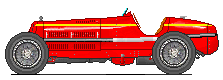
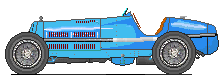
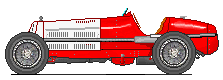
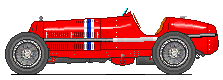
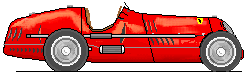
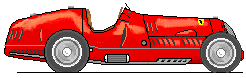
ALFA ROMEO S.A. Alfa Romeo, Milano |
|
For the first few years after 1901, the Darracq was one of the best-known marques in Europe, produced under license by Opel in Germany, and 1906 in Italy first in Naples as Societá Anonima Italiana Darracq but after
a year moved to Milan building a factory at Il Portello district. Within two years it was disastrous for Darracq and, in 1909 bankruptcy threatened.
The Banca Agricola Milanese plowed one-half million lire into the enterprise. Completely reorganized with Giuseppe Merosi as chief designer and Ugo Stella remained managing director on the 24 June 1910 the company became the Anonima Lombarda Fabbrica Automobili or known by its initials A.L.F.A. The new cars were identified by an emblem reading ALFA MILANO. Giuseppe Merosi was a man literally in love with cars. He had a vast knowledge of the automobile world, which he was able to pass on with simplicity to a team of about twenty designers, all of them Milanese except one from Naples. Thus, the first A.L.F.A. created, was the "24 HP" with a 4-cylinder 4085cc engine, 100 km per hour. It gained immediate favor with the customers who preferred it for the excellent pickup of its engine. The "20-30" type succeeded the first model (the figures were indicating the data for taxable and effective power), then the "15/20" and, from 1913, the "40/60" of which 27 specimens were built. In 1914 a new 4.5-liter racing formula was established, when Merosi built a car suitable for international competitions to let their name and products well known abroad. The first successful road test at Brescia circuit with the 80 hp Grand Prix car was performed early May 1914 but due to new wartime conditions, the GP entry was withdrawn. During 1915, Ugo Stella's administration failed to find a way to function profitably in the wartime emergency and by August ALFA was all but dead. In September 1915 ALFA was put into liquidation and absorbed by the industrialist Nicola Romeo, then named SA Italiana Ing. Nicola Romeo & C. After World War 1, the pre-war models were marketed as Alfa Romeo. The early 1922 models were the 20-30 ES Sport models with 4.3-Lilter 4-cyl engines giving 67 hp at 2600 rpm and were superseded by the RL series. The RL touring models were started in 1922 with RL Sport. At 1922 hill climbs, on 8. January Antonio Ascari with an Alfa Romeo 20/30 ES won the 10 km Gargnano-Tignale hill climb (Lake Garda), p/o Coppa Garda. For 1923 they developed the RL Targa Florio, re-bored to 3154 cc (78 x 110 mm), giving 96 hp at 3800 rpm and with shortened wheelbase of 288 cm while the RLSS had 314 cm. For the Targa Florio five RLTF's were entered, two of them with the larger engine. At 1923 hill climbs, on 17. June Giulio Masetti in an Alfa Romeo RL 3.0 won the 15 km Coppa della Consuma (Florence) hill climb. Vittorio Jano left Fiat in September of 1923 and took up his duties at Alfa Romeo in October. Griffith Borgeson wrote: Jano liked Ing. Romeo, whom he described as "a kind and persuasive man." He said that Romeo told him at the outset of the P2 project, "I don't pretend that you should build a world beater for me, but I want you to build me a Grand Prix car that will give this company a competitive image." In 1924, the P2 Grand Prix car won at Cremona with Ferrari, Campari won the European Grand Prix in France and Ascari won the Italian Grand Prix. At 1924 hill climbs, on 21. January Enzo Ferrari with an Alfa Romeo RL SS won the 10 km Gargnano-Tignale (Lake Garda) hill climb. On 11. May Antonio Ascari with an Alfa Romeo RL SS won the 50.9 km Parma-Poggio di Berceto hill climb. On 18. May Giuseppe Campari with an Alfa Romeo won the 5.6 km Gempen hill climb near Basel in Switzerland. On 1. June Campari with a 6-cyl. Alfa Romeo won the 5.96 km Montreux-Caux hill climb. In 1925 Alfa Romeo won the first world championship. To celebrate the victory Alfa Romeo added a wreath around its coat of arms. Then Alfa Romeo withdrew from Grand Prix racing. Yet in the following years the P2 took part in free-formula races winning important events, while the private drivers received Alfa Romeo works support. In 1926 Alfa Romeo had withdrawn from Grand Prix racing. Brilli Peri's winning P2 1925 at Monza went in 1926 to Josef Kessler in Switzerland, who won a Speed Trial near Zürich. He was first at the Monte Ceneri hill climb and won at Klausen with his P2. At the Rome Grand Prix, Campari and Bonmartini, both in P2's, finished 2nd and 3rd behind Maggi's T35 Bugatti. At the Freiburg Speed Trial in Germany, Campari set the fastest time at 198.350 km/h. In January 1927 Bonmartini won the hill climb at Rome with a P2. In March, Maggi ran a P2 at Tripoli but retired. Maggi's P2 appeared next in Argentina, where after demonstration runs some races, it was sold back to the factory in 1930. Josef Kessler with a P2 beat his 1926 record at the Zürich Speed Trial and later at Klausen he ran into engine trouble. Campari's P2 won the Coppa Acerbo and he finished 2nd at the Monza Milano Grand Prix. In June 1928, Campari retired his P2 at Mugello and was last at Cremona. After winning a hill climb, Campari again won the Coppa Acerbo. In September at the European Grand Prix at Monza Campari with Varzi came second behind Chiron's Bugatti T35C. At 1928 hill climbs, on 8. July Giuseppe Campari won the 22.1 km Susa-Moncenisio,hill climb with an Alfa Romeo P2. In March 1929 at Tripoli, the P2 of Varzi retired but he won at Alessandria. In May at the Rome Grand Prix Vazi's P2 won while Brilli Peri came second. At the Coppa Ciano Varzi won and Brilli Peri's P2 was fifth. At the Monza Grand Prix Varzi won and Brilli Peri came fourth. Two weeks later at Cremona Brilli Peri won while Varzi's P2 retired. At the Tunis Grand Prix Brilli Peri won while Varzi retired after a few laps. With six wins in 1929, it was the most successful year for the P2 Alfa Romeo. At 1929 hill climbs, on 16. June Achille Varzi won the with an Alfa Romeo 6C 1750 SS the 13.5 km Trieste-Opicina hill climb. In 1930 the Alfa Romeo P2 in revamped form made its last appearance after Alfa Corse had bought back three of the old P2's at the end of 1929. Vittorio Jano supervised extensive modifications to chassis, engine and body. Besides the revived P2, Alfa Romeo had also several types of the 6C-1750 sports car available for 1930. The P2's were first entered by the Portello factory, driven by Varzi or Nuvolari only at Alessandria, Targa Florio, Rome and the Coppa Ciano. Varzi drove the same P2 he had raced here the year before, which he had sold back to the Portello works at the end of 1929. Equipped now with the latest factory modifications, this was to be the first and final test for the revamped Alfa Romeo P2 before the upcoming most important Targa Florio. Ignoring the fact that the car belonged to the Portello factory, Varzi supposedly ran as an independent entry as was the entire field. For the newly formed Scuderia Ferrari this was only their second race. Enzo himself was driving a new 6C-1750SS. Varzi won the race in record time with the P2 to be entered also in the upcoming Targa Florio where Varzi again was victorious and survived all sorts of difficulties in probably his most outstanding drive ever. By breaking the existing records, he ended Bugatti's 5-year string of Targa victories. At the Rome Grand Prix Varzi's P2 Alfa Romeo retired with a clutch problem and Nuvolari's P2 broke a piston. At the Coppa Ciano, Varzi's P2 broke the differential while Nuvlari's P2 retired with a clutch problem. Later, as the racing operation moved to the newly founded Scuderia Ferrari, cars were entered by the Scuderia at the Coppa Acerbo where Nuvolari's P2 lost power during the race and finished in fifth place while Varzi had changed over to Maserati and won the race. At the Monza Grand Prix Nuvolari, Borzacchini and Campari all started in P2's entered by the Scuderia Ferrari, contracted to race with Pirellis. All three P'2's retired after only around 40 km when their Pirelli tires came apart, and the cars were retired. At the Masaryk Circuit in Czechoslovakia two cars started for Borzacchini and Nuvolari. The latter drove Varzi's Targa Florio P2 model with one spare wheel in the tail, he retired with a cracked crank case. Thereafter he took over Borzacchini's leading P2 eventually finished third with broken water pump. After seven successful years, it was the swansong for the P2 Alfa Romeo. At 1930 hill climbs the P2 car was seen with Nuvolari who won the 9.5 km Trieste Opicina climb, the 66.5 km Cuneo-Colle della Maddalena and the 14.8 km Vittorio Veneto-Cansiglio hill climb. During the 1931 season Alfa Romeo entered their team at only five events at the Targa Florio, the Italian, French, Belgian and Monza Grands Prix. Other races were entered by the Scuderia Ferrari, often using the same cars and drivers. The Alfa Corse team manager was the outstanding Aldo Giovannini for the three main drivers Giuseppe Campari, Tazio Nuvolari and Baconin Borzacchini. Other drivers were Luigi Arcangeli, Guido D'Ippolito, Ferdinando Minoia (who became the 1931 European Champion), Giovanni Minozzi and Goffredo Zehender. Alfa Romeo was well prepared for the May 10 Targa Florio, entering two brand new 2300, 8-cylinder racecars equipped with bucket seats, a cylindrical exposed fuel tank and two spare wheels on the back, also several 6C 1750 cars. Nuvolari won with the 8C-2300 while the second car driven by Arcangeli came sixth. The designer Vittorio Jano with team manager Aldo Giovannini supervised the team. At the Italian Grand Prix, they again had two of the new 8-C-2300 cars, which had been further improved since their Targa Florio victory and one twin 6-cylinder 3.5-liter tipo A monoposto. The complexities of the dual power trains made the car hard to handle. Arcangeli crashed fatally during practice for the Grand Prix on the Monza course, with the chassis now distorted. Alfa Romeo management contemplated withdrawing from the race in mourning for their driver, as they had done in 1923 when Ugo Sivocci had crashed at Monza in the same corner. The evening before the race they received a telegram from Italo Mussolini, head if the fascist government, ordering them to compete and win, which changed their mind. It was crucial for Italian prestige that an Italian car won the Italian Grand Prix, not a Bugatti from France. Entered for the first time at the Italian Grand Prix, the new 12-cylinder single seater Type A was on the starting line with Nuvolari at the wheel. His run ended on lap 32. The retirement of Alfa Romeo's 12-cylinder monoposto has been variously described as either an intentional withdrawal by Jano or a differential failure. Luigi Fusi, Alfa Romeo's historian, gave the most credible account. On lap 32, Nuvolari passed the pits with a dead engine and stopped at the first turn from where he walked back to the pits. (After the race, it was determined that the main bearings of one engine had seized due to lack of oil from the wet sump when cornering at high speed. Consequently, the engines were later reverted to dry sump lubrication.) But the 8C-2300 won the race and became known as the Monza model in honor of this first Grand Prix victory at the 24 May 1931 Italian Grand Prix, held at the Autodromo di Monza. For the French and Belgian Grand Prix, Alfa Romeo sent three of their latest 2300 straight-8 Monza, finishing second behind the Bugatti T-51 in both races. At the September Monza Grand Prix, the Alfa Romeo factory entered two of the twin 6-cylinder 3.5-liter tipo A monoposto and three 8C 2300 Monza models but without success In June the Pontedecimo-Giovi hill climb and the October Coppa della Consuma climb were won by Nuvolari with an Alfa Romeo Monza. In 1932 Alfa Romeo entered racing events under their 1932 factory name. For the early 1932 entries they employed the previous year's 8C-2300 2-seat racecar, also known as the Monza models in honor of their first Grand Prix victory at the 1931 Italian Grand Prix at the Autodromo di Monza. At the Italian Grand Prix in June 1932 the new Alfa Romeo tipo B monoposto made its first appearance and by winning this event became their main weapon. After this great victory at its first race, the tipo B was commonly called "P3", in recognition of being a worthy successor to the victorious P2, eight years before. The team manager was the outstanding Aldo Giovannini for the three Italian drivers Tazio Nuvolari, Mario Umberto Borzacchini and Giuseppe Campari under contract plus the German Rudolf Caracciola. The German became a fully-fledged team member only after the Monaco Grand Prix and helped winning races for Romeo with the P3 in 1932. SA Alfa Romeo participated at major races like the Grand Prix of Monaco, Italy, de l'ACF and Germany, the Coppa Ciano, Coppa Acerbo, the Grand Prix of Monza and Marseille. Ferrari also entered the Portello works top drivers with cars at the Targa Florio and at the Masaryk Circuit. Scuderia Ferrari (Modena, Italy) participated in only six major events, mostly finishing in the mid field. Drivers sent to these races were primarily Antonio Brivio and Pierro Taruffi but also Pietro Ghersi and Eugenio Siena with Gianfranco Comotti once at the Rome Grand Prix. The Scuderia contested only two events outside Italy, the Tunis Grand Prix and Masaryk Circuit. Since the Alfa Romeo works team in Portello entered most of the major races, Scuderia Ferrari cars played a lesser role. However, at the Targa Florio, Ferrari's organization took part with half of the Portello team, winning with Nuvolari and Borzacchini in the first two places. Nuvolari also drove for the Scuderia at the Masaryk Circuit near the year's end, finishing in third place. The Scuderia operated with the less powerful Alfa Romeo 8C 2300 Monza models and had no chance to compete against the stronger and more modern Alfa Romeo works cars. Only on one occasion did the Portello factory release a tipo B/P3 monoposto to Ferrari, near year's end at the Masaryk Circuit for Borzacchini to drive, but the expected success was not achieved. In June Rudolf Caracciola won at the German Kesselberg with a Monza, Borzaccini won the Pontedecimo-Giovi hill climb with a Monza, in July Caracciola won the Austrian Gaisberg climb and in August the Swiss Klausen climb and the German Schauinsland (Freiburg) climb with an Alfa Romeo Type B/P3. In September Caracciola won the 21.600 km Mont Ventoux in France with a Monza. The year 1933 was dominated by Alfa Romeo. Tazio Nuvolari was again the most commanding driver, a repeat from the year before when he was crowned European Champion. In 1933 he won seven grand prix races, the Mille Miglia with Decimo Compagnoni and the Le Mans 24-Hour race with Raymond Sommer. Scuderia Ferrari inherited many drivers at the end of 1932 when Alfa Romeo had withdrawn from motor racing for financial reasons. To Ferrari's great dismay, they would not release towards the Scuderia their very successful Tipo B/P3 monoposto racecars, which had been so dominating in 1932. Therefore, Enzo Ferrari's alternative was to modify the old 8C-2300 Monza models, of which he had six cars. He increased their engines to 2.6-liter capacity. But these cars were still insufficiently strong and robust to beat the faster Bugatti and improved Maserati monoposto. Due to the increased engine power during the later races these cars often broke down with differential problems. Top drivers were Nuvolari and Borzacchini, who both left dissatisfied with Ferrari's cars at the end of July, driving then for Maserati. The Scuderia replaced both deserters with Fagioli as team leader, then added Campari and later Chiron. Once the Alfa Romeo factory realized why Nuvolari had left the Scuderia and saw the performance of the improved 8CM Maserati, they released their Tipo B Monoposto racecars from 1932 together with spares and some key technicians to Ferrari. With these cars Alfa Romeo was able to meet the challenge of the fast Maserati monoposto. The Scuderia normally ran their cars in Italy on Pirelli tires but due to lucrative contracts used Belgian Englebert at the international events. In July Borzacchini won the 22.100 km Susa-Moncenisio hill climb with an Alfa Romeo Monza, in August Mario Tadini won the 14 km Stelvio hill climb with a Monza; in September Trossi won the 10 km Monte Ceneri with an Alfa Romeo Type B/P3. Other independent drivers were winning hill climbs with Alfa Romeo cars. The 1933 Monza Grand Prix will always be remembered as the Black Day of Monza. Three of Europe's greatest racing drivers had crashed fatally within a few hours of each other at almost the same spot in the South Curve: Campari, the most popular driver, the bulky, amiable Giuseppe, then Mario-Umberto Borzacchini, the great driver and famous friend of Nuvolari and finally Count Stanislas Czaykowski. In 1934 the new AIACR 750 kg formula went into effect and Alfa Romeo improved their Tipo B/P3 with a more powerful 2.9-Liter engine conforming with the formula. The fascist Government of Mussolini stepped in to prevent bankruptcy, organized Alfa Romeo to work under state owned Istituto di Ricostruzione Industriale (IRI) and was that way able to put government money into Motor racing. The Alfa Romeo cars were raced by the Scuderia Ferrari with Achille Varzi, Louis Chiron, Guy Moll, Count Trossi and Marcel Lehoux. At the April Monaco Grand Prix Moll won ahead of Chiron, both in 2.6-L tipo B/P3 and Varzi in a 2.9-L finished sixth. At Alessandria Chiron won with a 2.9-L and Mario Tadini came second in a 2.6-L Tipo B/P3. In May at Tripoli Varzi won ahead of Moll and Chiron, all with the 2.9-L cars. At the Targa Florio Varzi won again with the 2.9-L car. At Casablanca Chiron came first and Lehoux third, both with 2.6-L cars. At the Avusrennen Moll won with a modified bored out engine to 3.2-L Tipo B/P3 ahead of Varzi in a 2.9-L car. At the Eifelrennen in June, Chiron finished third with a 2.9-L car behind a Mercedes-Benz and an Auto Union. At Montreux Trossi came first and Varzi third, both with 2.9-L cars. At Penya Rhin (Barcelona) the three entries of Varzi, Chiron and Lehoux won the first three places, all in 2.9-L cars. In July at the French Grand Prix, Chiron, Varzi and Moll finished again in the first three places with 2.9-L cars. At the following Marne Grand Prix, Chiron, Moll and Varzi with Marinoni finished in the first three places in 2.9-L cars. At the German Grand Prix Chiron came third with a 2.9-L car behind an Auto Union and a Mercedes-Benz. At Vichy in France Trossi won while Lehoux came fifth, both with 2.9-L cars. In the following race at Dieppe Lehoux with a 2.9-L came second behind a 3-L Maserati of Etancelin, while Chiron retired. At the Coppa Ciano Varzi won ahead of Moll with 2.9-L cars while Trossi came 4th and Barbieri 5th. At the Belgian Grand Prix, Varzi and Chiron in 2.9-L cars, both retired. In August at Coppa Acerbo Ghersi and Varzi in a 2.9-L car finished in 4th place..At this event they lost their driver Moll in a fatal accident. At the Nice Grand Prix Varzi won and Trossi came 3rd, both in 2.9-L cars. At the Swiss Grand Prix Varzi came 4th, Chiron 5th and Ghersi 7th behind strong opposition. At Comminges in France Comotti won with a 2.9-L car while Lehoux retired. In September at the Biella circuit Trossi won ahead of Varzi, both in 2.9-L cars. At the following Italian Grand Prix Trossi with Comotti came 3rd, Chiron 4th and Comotti with Marioi 6th. At the Spanish Grand Prix Varzi with Chiron came 5th and Chiron with Comotti 9th against strong opposition. At Masaryk in Czecholovakia against strong German opposition, Varzi's best was 5th place while Chiron and Comotti retired. In October at the Modena Grand Prix Varzi and Tadiniin in 3.2-L cars, Barbieri and Ghersi in 2.9-L cars finished behind Nuvolari's Maserati. At the following Naples Grand Prix, Nuvolari won again, Brivio came 2nd, Tadini 3rd and Comotti 5th, all in 2.9-L cars. At the Algerian Grand Prix Chiron encountered trouble finishing second behind a faster Bugatti of Wimille. This ended one of the busiest racing seasons for Scuderia Ferrari. In August at the Stelvio hill climb Mario Tadini won with a Tipo B/P3. The 1935 Alfa Romeo P3 cars were bored out to 3.2-Liter and were fitted with independent suspension. In February at the Pau Grand Prix, Nuvolari won, followed by Dreyfus in 3.2-L P3's. In April at the Monaco Grand Prix, Scuderia Ferrari entered five cars. Dreyfus finished second in a 3.2-L P3 behind the winner Fagioli in a Mercedes-Benz. Brivio came 3rd, Chiron 5th and Sommer 6th, all in P3's, while Nuvolari with Trossi retired. At the following Targa Florio Scuderia Ferrari entered three P3 cars. Brivo won, Chiron came 2nd and Pintacuda retired. Nuvolari planned to race independently with Maserati, but Benito Mussolini made it clear that he wanted Nuvolari to lead the Alfa Romeo team. In May at the Tunis Grand Prix, Nuvolari broke a piston while Comotti's 2.9-L P3 finished in fourth place. One week later at Tripoli, Ferrari entered two P3's. Comotti finished 4th behind faster German cars, while Nuvolari's 3.2-L P3 again broke a piston. At the Bergamo Circuit, Nuvolari won, Pintacuda came 3rd and Comotti 5th, all in 3.2-L P3's. The Scuderia Ferrari at Modena built the Monoposto Bimotore of 1935, primarily designed by Luigi Bazzi based on Jano's P3 engines and drive shafts, intending to beat the German cars at the fast circuits like Avus and Tripoli. The new twin engined 5.8-L formula libre cars appeared at the Avusrennen in Berlin, Chiron finished 2nd with the 5.8-L Bimotore behind Fagioli's Mercedes-Benz. Dreyfus came 6th with a 3.2-L P3, while Nuvolari's Bimotore failed to reach the final stage after making two pit stops. In June at the Biella circuit, Nuvolari won ahead of Chiron, Tadini came 5th and Trossi retired. At the Eifelrennen Chiron finished 3rd behind two German cars, while Dreyfus came 7th. One week later at the French Grand Prix both Chiron then Nuvolari retired their 3.2-L P3's with broken rear differential. At Penya Rhin (Barcelona) Nuvolari and Brivio finished 3rd and 4th with 3.2-L P3's behind the two winning Mercedes-Benz. On the same day in France at the Lorraine Grand Prix, a 3-hour race near Nancy, Chiron won while Comotti finished 3rd both in 3.2-L P3's. In July at the Marne Grand Prix Dreyfus won and Chiron came 2nd, both in 3.2-L P3's. The first Turin Grand Prix was won by Nuvolari, Brivo came 2nd, Pintacuda 3rd, Tadini 5th while Trossi retired, all with P3's. At the Belgian Grand Prix Chiron finished 3rd and Dreyfus with Marinoni 4th in 3.2-L P3's behind the two winning Mercedes-Benz. At the Dieppe Grand Prix Dreyfus won ahead of Chiron in 3.2-L P3's. The German Grand Prix was won by Nuvolari in a 3.2-L P3. His victory over nine superior German cars was considered Nuvolari's greatest race. Brivio retired with broken differential while Chiron broke a piston, both in 3.2-L P3's. In August at the Comminges Grand Prix the independent Raymond Sommer was the winner in an Alfa Romeo 2.9-L P3, while Chiron finished 4th and Comotti broke the rear axle on their 3.2-L P3's. The Coppa Ciano was won by Nuvolari, Brivio was 2nd, Trossi 3rd and Dreyfus 4th, all with 3.2-L P3's. The Coppa Acerbo was won by two Auto Unions with the Ala Romeo 3.2-L P3's of Brivio 3rd, Comotti 4th, Tadini 5th, Chiron with Pintacuda 6th and Nuvolari retired. The Nice Grand Prix was won by Nuvolari, Chiron came 2nd and Dreyfus 3rd in 3.2-L P3's. The Swiss Grand Prix was dominated by four German cars while Nuvolari came 5th, Dreyfus 7th and Chiron retired. In September at the Italian Grand Prix Scuderia Ferrari arrived with the new Alfa Romeo 8C-35 monoposto which was to replace the P3 car. It had fully independent suspension. Two cars were entered for Nuvolari and Chiron. Initially the car had been planned with a V-12 engine but since it became too heavy, exceeding the 750 kg limit, a 3.8-Liter straight eight had to be used this time, delivering 330 hp at 5,400 rpm. Attilio Marinoni, Scuderia's ex-works chief test driver, drove one of the old Alfa Romeo Tipo B/P3 with 3.2-Liter engine and independent front suspension. René Dreyfus was selected to drive the second 8C-35 while the sick Chiron acted as reserve driver. Besides Enzo Ferrari, there was engineer and test driver Gianbattista Guidotti, the engineer Luigi Bazzi. A German car won but Dreyfus with Nuvolari came second in an 8C-35, Attilio Marinoni was fourth in a 3.2-L P3 while Nuvolari broke a piston on his 8C-35. The following Modena Grand Prix was won by Nuvolari in an 8C-35, Tadini finished 2nd, Pintacuda 3rd, Brivio 4th while Marinoni and Comotti retired all in 3.2-L P3's. At the Spanish Grand Prix three Mercedes-Benz won while Nuvolari retired his 8C-35 car and Chiron withdrew his 3.2-L P3. At the Masaryk Grand Prix, Nuvolari's 8C-35 finished 2nd after Rosemeyer's winning Auto Union, Chiron came 3rd and Brivio 4th, both in 3.2-L P3's. The Lucca Circuit was won by Mario Tadini, Comotti was second and Pintacuda third all in.2.9-L P3's. In October at the Coppa della Sila in the very south of Italy, Brivio's 3.2-L P3 was the winner, while Pintacuda retired with the same type. In August 1935 at the 19.500 km Grossglockner hill climbs (Austria) was won by Mario Tsadini with a type B/P3. In September Tadini also won the 14.000 km Stelvio hill climb with a type B/P3. In 1936 politics interfered with racing. When on 3. October 1935 Italian troops invaded Abyssinia, the League of Nations on 18. November 1935 imposed economic sanctions on Italy. Mussolini answered by boycotting the French and British motor sport events. The Spanish Civil War began on 18. July 1936. Alfa Romeo developed the Type 8C-35, now fitted with a new 4.1-L V-12 engine. The new model was known as Type 12C-36. The Scuderia Ferrari still managed the team with Nuvolari, Brivio, Pintacuda, Tadini and Dreyfus, who joined from the Deauville GP onwards, while Giuseppe Farina was a new driver and Trossi left for Maserati. Scuderia Ferrari had sold eight of their nine 1925 Alfa Romeo Tipo B/P3 cars to independent drivers. The Bugatti factory team entered a T59 for jean-Pierre Wimille. In March 1936 at the Pau Grand Prix the Scuderia Ferrari entries of Nuvolari, Brivio and Giuseppe Farina were stopped by an order of Mussolini. However, Secretary of the Fascist Party, Achille Starace, had announced that Italian drivers could start abroad without problems. The Ferrari team was already on its way to France when it was stopped at San Ludovico, the French border, and ordered to return to Modena. No Italian team should race in France until after a meeting of the league of nations on 10. March where a decision regarding a possible tightening of the sanctions against Italy would be made. At the same time the race organizers got a telegram from Giuseppe Furmanik, President of the RACI Sporting Commission stating their participation is revoked by superior authority. In April at the Monaco Grand Prix behind three German winning cars, Nuvolari finished 4th, Brivio with Farina came 5th while Farina and Tadini retired, all in 8C-35 cars. In May at Tripoli Alfa Romeo introduced the 12-cyl. car with 4.064 cc engine. The German cars finished in the first four places, behind them Pintacuda in an 8C-35 came 5th, Tadini 6th, Brivio 7th and Nuvolari 8th, all three in the new 12C 36 cars. One week later at the Tunis Grand Prix, Pintacuda's 8C-35 finished 2nd behind the winning Mercedes. Brivio in a 12C-36 retired. In June at Penya Rhin (Barcelona) Nuvolari won with the 12C-36 beating Caracciola's Mercedes while Farina finished 3rd in an 8C-35, and Brivio retired in another 8C-35. In June at the Eifelrennen, behind the winning Auto Union of Rosemeyer, Nuvolari finished 2nd and Brivio 3rd both in 12C-36 cars while Farina came 4th while Severi retired, both in 8C-35 cars. One week later at the Hungarian Grand Prix Nuvolari won in an 8C-35 beating the Auto Union and Mercedes, while Tadini finished 4th in an 8C-35. At the Milan Grand Prix Nuvolari won with a 12C-36, beating the Auto Union of Varzi. Farina came 3rd, Brivio 4th and Tadini 5th, all three in 8C-35 cars. In July Scuderia Ferrari travelled with two cars to Brazil at the Sao Paulo Grand Prix. Pintacuda won and Marinono finished second both in Alfa Romeo 2900A sports cars. At the Deauville Grand Prix, the two 8C-35 of Farina and Dreyfus retired. At the German Grand Prix Brivio finished third in an 8C-35 while Dreyfus, Severi and Nuvolari retired. In August at the Coppa Ciaano Pintacuda with Nuvolari won in an 8C-35, Brivio's 12C-36 came 2nd, Dreyfus' 8C-35 3rd and Nuvolari's 12C-36 retired. One week later at the Coppa Acerbo, three Auto Unions won but Brivio's 12C-36 came 4th while Nuvolari, Dreyfus and Farina retired. At the Swiss Grand Prix, Farina, Nuvolari and Dreyfus retired. In September at the Coppa Edda Ciano, Tadini won, Pintacuda came second and Brivio retired, all in 8C-35 cars. One week later at the Italian Grand Prix, Rosemeyer's Auto Union won, Nuvolari's came 2nd and Dreyfus 4th, both in 12C-36 cars, Pintacuda was 5th in an 8C-35, and Farina crashed his 12C-36. At the Modena Grand Prix Nuvolari's 12C-36 won, Tadini came 2nd and Farina 3rd, both in 8C-35's, Severi was 4th in a 2900 A and Pintacuda retired. In October Scuderia Ferrari travelled to New York for the Vanderbilt Cup Race, which was won by Nuvolari, Brivio came 3rd and Farina retired, all with 12C-36 cars. On 30. August 1936 Alfa Romeo with Mario Tadini won the 14 km Stelvio hill climb, Trossi was 2nd and Biodetti finished 3rd. In March 1937 Alfa Romeo bought 80% of the shares of Scuderia Ferrari. This meant that Alfa managing director Ugo Gobbato took full control of race activities. Scuderia Ferrari continued to function as the Alfa works team with Enzo Ferrari now reduced to "mere" team manager. The driver lineup was Nuvolari, Farina and Brivio while Dreyfus had left Ferrari for Maserati. Reserve drivers included Pintacuda Biondetti, Tadin, Severi, Siena, Trossi and Sommer. The team continued with their 4.1-L 12-cyl. type C cars in 1937 but they were totally outclassed by the German cars. Therefore, Vittorio Jano built a new lower chassis for a 4.5-L engine, known as type 12C/37 to race as late as August. In April at the Turin Circuit, Brivio finished 1st, Farina 2nd, Trossi 3rd and Pintacuda 4th, all in 12C-36. In this race Pintacuda in fact replaced Nuvolari, who crashed in practice and left hospital after three days with a plaster corset. The following week at the Naples Grand Prix, Farina won, Biondetti came 2nd, both in 12C-36, Villoresi was 3rd and Siena 5th. In May at Tripoli, the German cars finished in the leading places. The best Alfa Romeo 12C-36 was Farina ninth, Brivio tenth, Sommer eleventh, and Tadini twelfth while Nuvolari and Trossi retired. In May at the Avusrennnen the three entries of Nuvolari Brivio and Farina were withdrawn. The Scuderia Ferrari discreetly withdrew their entry of three Alfa's in the last moment, quite understandably, considering the high speeds to be expected. The reason given for this withdrawal was that the cars could not be prepared for a new race in such a short time since the Tripoli Grand Prix. It would have most likely been a hopeless race for them. Instead, they entered four cars at the Genova Grand Prix, held the same day, taking the first three places. However, Scuderia Ferrari's top driver, the always popular Tazio Nuvolari, showed up at the Avus as a spectator, taking photographs of his fellow drivers and watching the race from the Auto Union pits. At Genova Trossi won and Tadini came second in12C-36's, Emilio Villoresi was 3rd in a 2900A while Biondetti retired his 8C-35. In June at the Eifelrennen, Nuvolari finished the 12C-36 in 5th place behind the German cars while Farina retired. At the Milan circuit Nuvolari won, Farina came 2nd and Trossi was 5th. At the Vanderbilt race in New York, Nuvolari retired but took over Farina's 12C-36 to finish 5th behind the winning German cars, including Rex Mays' 8C-35 Alfa Romeo in 3rd place. In July at the Belgian Grand Prix, Sommer finished 5th behind the German winning cars and Trossi retired the other 12C-36. Two weeks later at the German Grand Prix, Nuvolari's 12C-36 finished 4th behind the German cars, Marinoni's 8C-35 was 11th and Farina's 12C-36 retired. In August at the Monaco Grand Prix Scuderia Ferrari entered three cars, Farina's 12C-36 finished 6th behind the leading German cars, Pintacuda's 8C-35 came ninth and Brivio's 12C-36 retired. Vittorio Jano designed in autumn of 1936 a new lower chassis for a new 4.5-L engine, known as type 12C-37. Unfortunately, the manufacture of various parts was delayed due to the pressing demand for aero engines, and the first tests of the new car only carried out on the Bergamo Autostrada at the beginning of August by chief mechanic Gianbattista Guidotti and Nuvolari with satisfying results. On 15 August at the Coppa Acerbo the cars were entered not by Scuderia Ferrari but by the Alfa Romeo works team, which made its comeback to racing in August 1937 under the name "Alfa Corse". Two of the new Alfa Romeos appeared on Saturday practice for Nuvolari and Farina. Nuvolari's best time trying hard for five laps was 11m26s. The second car driven by Farina was not going at all well and broke down in practice. Nuvolari declared the new car not being ready to race but designer Vittorio Jano asked the Mantuan to test-drive in the race which would provide valuable data for the car's improvement. Only one of the 12C/37 cars started with Nuvolari and Farina took over after the fifth lap and retired the car after eight rounds. At the Swiss Grand Prix Nuvolari drove for Auto Union finishing seventh with Fagioli. The best 12C-36 Alfa Romeo, driven by Sommer, finished 8th while Farina retired. In September at the Italian Grand Prix in Livorno, Scuderia Ferrari entered five 12C-36 cars and Alfa Corse one of the new 12C-37. In the race Guidotti in the new 12C-37 stopped after 23 laps after skidding off the track. Nuvolari with Farina finished 7th in the 12C-36, Trossi came 8th, Belmondo 10th, Biondetti and Farina both retired. Luigi Fusi wrote, the negative result in this race caused Jano to retire from Alfa Romeo. Vittorio Jano left for Lancia and Ugo Gabbato was leading Alfa Romeo's design department. Two weeks later at the Masaryk Grand Prix, Nuvolari finished 5th and Brivio 6th, both in 12C-36 behind four faster German cars. On 16. May 1937, Mario Tadini won the 50.58 km Parma-Poggio di Berceto hill climb with an Alfa Romeo 12C-36. On 18. July Tadini won the 22.1 km Susa-Moncenisio hill climb with an Alfa Romeo 8C 2900A. For 1938 and 1939, the AIACR introduced the new 3-liter supercharged formula, based on a sliding scale of weight (from 400 to 850 kg) in relation to capacity. The weight led effectively to 3-liter S/C (supercharged) cars or 4.5-liter U/S (un-supercharged) cars with a minimum weight of 850 kg - 1873 lb. The weight includes tires, transmission- and differential oil gut not cooling water, engine oil, fuel, tools and spare wheels. The relation of supercharged to un-supercharged was 1 :1.5. Free choice of fuels; minimum race distance 500 km - 312 mi. The formula was in effect until February 28, 1946, when it was annulled at the first postwar AIACR meeting. On 1. January 1938 Scuderia Ferrari was dissolved. Racing was now handled by the Alfa Corse works team based at Milan with Enzzo Ferrari as team manager and Spaniard Wilfredo Ricard as chief designer. Alfa Romeo built a new car resembling the 12C-37 but with much improved road holding. The company built no less than three different new 3.0-L engines for the car, a straight 8-cylinder, a V-12 and a V-16. That was just too much, and the development programs suffered. Tazio Nuvolari was to be the leading driver for the team, but he resigned after the first race to join Auto Union. Brivio had retired so the Alfa Corse team had Farina, Tadini, and Pintacuda as drivers with Biondetti, Siena, Emilio Villoresi and Sommer to jump in occasionally. Halfway through the season Wimille also joined the team. On 10. April was the first race at the Pau Grand Prix. Alfa Corse entered two 308 types for Nuvolari and Emilio Villoresi. During final practice the saddle tank above the driver's legs sprung a leak. Fuel ignited, the car suddenly went up in flames, but Nuvolari managed to jump out just before the car came to rest on a grass verge, where it burned out. As a result, Villoresi's 308 was withdrawn since Alfa Corse feared a repetition of the problem. Nuvolari was picked up with a few burns to his face, legs and arms and was released from hospital back in Italy after about ten days. Thereafter Nuvolari left the Alfa Corse team. In May at the Tripoli Grand Prix, Alfa Corse entered four cars. Behind the three winning Mercedes, Sommer in a type 312, raced independently and finished 4th, Biondetti and Farina retired while Siena had a fatal crash. In June at Rio de Janeiro in Brazil, Alfa Corse started with two type 308. Pintacuda won and Tadini finished in 4th place. In July at the German Grand Prix, Nuvolari appeared again with H.P. Müller finished fourth in an Auto Union. Two Alfa Corse Type 312 entries were made for Farina and Biondetti, both retired. In August at the Coppa Ciano, the winner was Lang in a Mercedes, Farina finished 2nd and Wimille with Biondetti came 3rd, all in type 312's. At the Coppa Acerbo the winning Mercedes was driven by Caraccciola, Farina in a 312 finished 2nd while Biondetti's 312 retired. At the Swiss Grand Prix behind the winning German cars, Farina finished 5th and Wimille 7th both in 312's. In September at the Italian Grand Prix, Nuvolari in an Auto Union finished first, Farina in a 316 Alfa Romeo came 2nd, Biondetti in another 316 was 4th, while Wimille and Taruffi in 312's retired. On 24. April 1938 Mario Tadini won with an Alfa Romeo 2900 the 9.1 km Colli Torinesi (Sassi-Superga) hill climb. On 30. May Emilio Villoresi won in an Alfa Romeo the 50.58 km Parma-Poggio di Berceto hill climb. On 10. July Farina won with an Alfa Romeo 8C 2900 B the 9.65 km Pontedecimo-Giovi (Genova) hill climb. On 21. August Piero Dusio with an alfa Romeo won the 14 km Stelvio hill climb. The 1939 world situation affected the automobile races when early in the season Mussolini refused Italian drivers to race in French events because of the involvement in the Spanish civil war and deteriorating relations between the two nations. It was also decided that all major Italian races should be for 1.5-liter cars only. The fact that Daimler-Benz introduced their new Mercedes-Benz voiturette car at Tripoli and that Auto Union was building their own voiturette showed that 1.5-liter racing was gaining ground and probably would have been the new Grand Prix formula in the early 1940s if not the war had intervened. Alfa Romeo made only minor cosmetic changes to their Tipo 308, 312 and 316 cars. The company developed a new 16-cylinder car, the Tipo 162, but the car was never raced. Alfa Corse started in only a few races during the year with their lead driver Giuseppe Farina with Raymond Sommer mostly entered as an independent driver. 1939 in June at the Belgian Grand Prix was the first appearance of Alfa Romeo, it was to be also the last time the Italian team entered a 3-liter Grand Prix car. Alfa Corse entered an improved 316, unlike last year's model. It had a newer V-16 version of the 440 hp engine, a less wind resistant exhaust system, and smother body work. Farina retired just after mid-race with broken supercharger while Raymond Sommer was entered independently with a 308 and finished in 4th place behind three winning German cars. Sadly, Richard Seaman, England's best driver was killed. In July at the French Grand Prix independently entered Sommer finished 5th with a 308 Alfa Romeo. At the German Grand Prix, the independent Sommer retired his 308 Alfa Romeo. In August at the Swiss Grand Prix, Alfa Corse entered two tipo 158 in the voiturette class with Farina who finished 7th and Biondetti 9th after six superior German Grand Prix cars. On 2. July Mario Tadini won the 4.5 km Colli Torinesi (Sassi-Superga) hill climb with an Alfa Romeo 2900. With the onset of war in September, racing stopped in Europe. The information on above page was derived from the following Sources: Luigi Fusi, 1978; Sergio Puttini & Luigi Fusi 1982; Peter Hull & Roy Slater 1982; Joseph H. Wherry, 1967; Griffith Borgeson: Alfa Romeo Tradition, 1990; David Owen: Alfa Romeo, 1976; Hill climb winners list. | |
| (H.E.) | |
|
| |
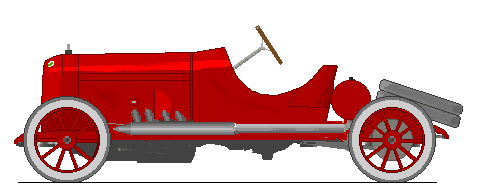 ALFA 1914
The Grand Prix 1914 ALFA with 4-cyl. 4490 cc, delivered 88 hp. Due to new wartime conditions, the GP entry was withdrawn. After the war the engine output was increased for the 1921 races, a new cylinder assembly and a modified valve system. The GP car was entered 1921 at Parma-Poggio di Berceto finishing third with Ascari, at Mugello Ascari crashed, and at GP Gentlemen (Brescia) Campari retired with leaking radiator, its last race. 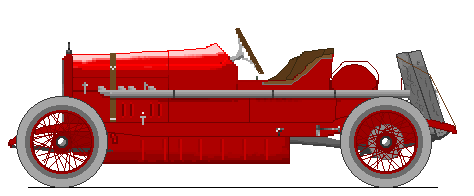 ALFA 20/30 ES sport
The ALFA 20-30 ES sport of 1921-1922 was based on ALFA 24 HP. The 20-30 ES sport was the first model to bear the ALFA ROMEO - MILANO inscription on its emblem. Driven by company drivers and customers who had purchased the car, it took part in important races in Italy; it spread the fame of the Milan car builder with numerous wins. Only one 1913 win by Frachini could be confirmed. The 20-30 ES sport models were still raced after the war in 1921 and 1922 without ever winning. Victories:
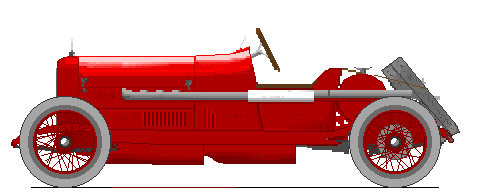 ALFA 40-60 hp tipo corsa
By the end of 1912 Alfa management developed a new sporting car, the 40/60 HP model with over 6-liler capacity and overhead valves. At Parma-Poggio di Berceto in 1913 and again in 1914, also at the Coppa Florio, Franchini and Campari accomplished good results. Both drivers raced after the war at the 1919 Targa Florio and up to 1922 contested various major Italian events. Victories:
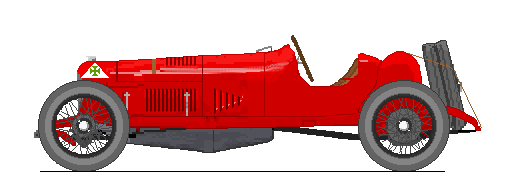 Alfa Romeo RL Targa Florio (1923)
The RL touring models were started in 1922 with the RL Sport and RL Super Sport entered at races with 2994 cc (76 x 110 mm) 6-cylinder engines giving 71 hp at 3500 rpm and 88hp at 3600 rpm for the RLSS. For 1923 they developed the RL Targa Florio with the 6-cylinder engine re-bored to 3154 cc (78 x 110 mm), giving 96 hp at 3800 rpm and with shortened wheelbase of 288 cm while the RLSS had 314 cm. This type was especially developed for the 1923 Targa Florio, five RLTF's were entered, two of them with the larger engine. Victories:
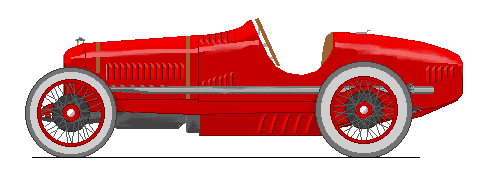 Alfa Romeo P1 (1923)
When the 2-liter formula was to go into effect in 1923, Alfa Romeo prepared three 6-cyliner Grand Prix cars with aluminum sheet metal bodies. For the September European Grand Prix at Monza Alfa Romeo entered a new type, called P1, of which three cars were present. During practice for this event Ugo Sivocci crashed one of the new cars and was killed. As a result, Alfa Romeo withdrew from the race. 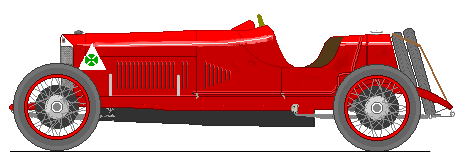 Alfa Romeo RL Targa Florio (1924)
To keep the positions achieved in the 1923 Targa Florio, five more cars were prepared in 1924 especially to run in that race. Two had 2994cc engines and three had 3620cc engines. This model, too, showed excellent qualities in the race and took overall 2nd, 3rd, 5th, and 10th places. This model surprised everybody with its brilliant performances displayed in the 1924 races. Victories:
 1925 Alfa Romeo P2
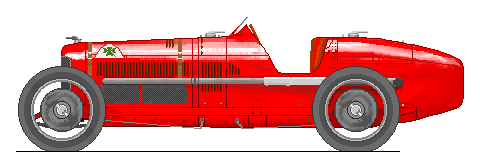
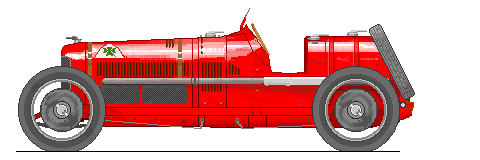
In 1923 the Management hired the designer Vittorio Jano who led a team, designing in 1924 and built a new Grand Prix car, the tipo P2 with a 1,987 cc, 8-cylinder, twin o.h.c. s/c engine, producing 140 hp at 5,500 rpm, giving a top speed of 225 km/h. This car won at Cremona and two major races with their lead drivers Campari and Ascari. Campari won the European Grand Prix in France and Ascari won the Italian Grand Prix. Louis Wagner was their third driver and Enzo Ferrari was part of the team but did not start at the European Grand Prix when he became sick. Thereafter Ferdinando Minoia joined the team for the Italian Grand Prix. For 1925, the last year of the 2-liter formula, the proven P2's had been fitted with bigger brake drums, and the power was raised to 155 hp by fine-tuning and using a special blend of fuel, producing a maximum speed of 240 km/h for their drivers Antonio Ascari, Giuseppe Campari and Gastone Brilli-Peri. After Ascari lost his life at the French Grand Prix, Peter DePaolo drove the third Alfa Romeo at Monza. In 1925 Alfa Romeo won the first world championship. To celebrate the victory Alfa Romeo added a wreath around its coat of arms. In the following years 1926-1929 this model took part in non-formula races and won other important events. Victories: 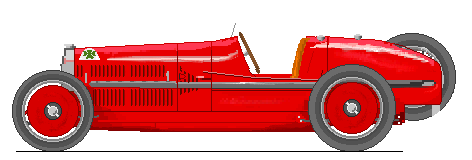
 1930 Monza Grand Prix 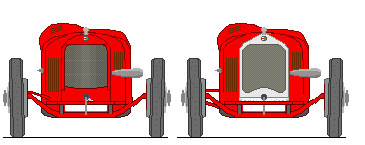 1924-29 1930 Alfa Romeo P2 (1930)
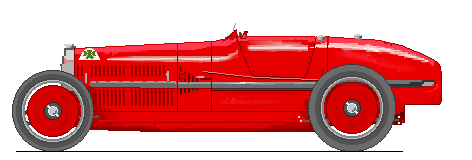
In 1930 the Alfa Romeo P2 in revamped form made its last appearance after Alfa Corse had bought back three of the old P2's at the end of 1929. Vittorio Jano, who had designed the P2 in 1923, supervised extensive modifications to chassis, engine and body. Wider axles, steering and brakes from the current 6C-1750 sports car improved the road holding maintaining however the original P2 frame. Both rear springs were now outside the chassis, as close as possible to the wheels to perk up the suspension. The bull nose of the original car was replaced with a flat leaning radiator. The P2 for Varzi had extra weight shifted towards the back by mounting the spare wheel into a vertical slot of the pointed tail, surrounded by a smaller fuel tank. The capacity of the 8-cylinder engine was raised from 1987 ccm to 2006 ccm by increasing the bore and this made it possible to compete in races above 2000 ccm. The supercharger was moved between carburetor and engine. With a different fuel mix the power was raised from 155 to 175 hp producing a top speed of 225 kmh. Victories:
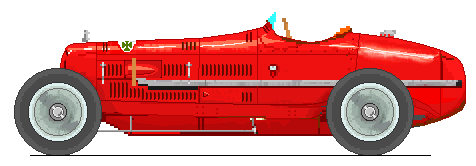 Alfa Romeo Tipo A
Victories:
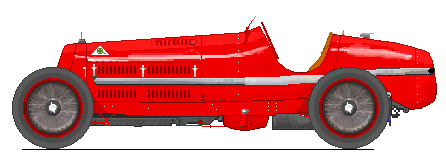 Alfa Romeo "Monza"
The supercharged straight eight 2.3 litre Alfa Romeo sports cars first appeared at the Mille Miglia in April 1931. In May the short wheelbase racing variant of the car was entered for the Italian and European Grand Prix at Monza, Campari and Nuvolari driving the car to victory. After that race the 2.3 litre racing cars became known as the "Monza". The cars were replaced in the Alfa Romeo works team by the Tipo B in 1932. For 1933 Scuderia Ferrari had to use "Monzas" with the engine volume increased to 2.6 litres before the team was able to receive the ex-work Tipo Bs. By 1934 the "Monzas" remained in the hands of privateer drivers. Some of the cars were rebuilt to Monopostos, notably the ones owned by Swedish driver Widengren, Norwegian Björnstad and German Pietsch. The popularity of the car among the privateers is seen by the following list of "Monza" entries: Gruppo San Giorgio (Balestrero , Scuderia Siena (Soffietti, Nuvolari, Scuderia Subalpina (Siena, Ghersi, Independents:Banti, Barbieri, Battaglia, Battilana, Björnstad, Bonetto, Danese, Delpino, A Dobson, Dodson, Eyston, Falchetto, Farina, Fontes, Gazzabini, Hellé-Nice, Maag, Magistri, Martin, Minozzi, Pages, Pellegrini, Penn-Hughes, Pietsch, Powys-Lybbe, "Raph", Rosa, "Sarubbi", Scaron, Soffietti, Sommer, "Ventidue", Westerblom, Widengren, Wilkins and Zanelli. Victories: Color scheme examples:
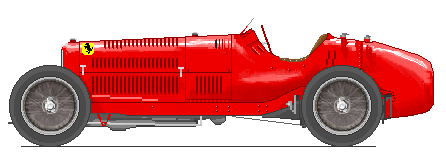
Alfa Romeo Tipo B Monoposto "P3"
The classic "Tipo B" was the first significant Grand Prix car to use streamlined single seater bodies. When the 2.6 litre car appeared in 1932 it was simply known as the "Monoposto". For 1934 the car was upgraded with a 2.9 litre engine and wider bodywork to conform with the 750 kg formula. The 2.9 litre car was offically known as the Tipo B. Also the 2.6 litre car became retrospectivly known as Tipo B. Among the press the car, as the successor to the Alfa Romeo "P2", has been called the "P3" but it remains doubtful if it that name was used officially. The engine was similar in design to the 2.3 litre engine used in the "Monza". With a new alloy block the engine with its twin superchargers on the left side had a wide powerband and excellent low speed torque, giving the light chassis a good acceleration out of corners. The gearbox was the same as for the "Monza" and proved to be the weakest part of the car as it was unable to withstand the power of the enlarged engines. The gear lever was to the left of the steering wheel. Unique to the car were the dual propeller shafts, one for each wheel, that run from the single differential behind the gearbox to small housings near the wheels. With the half shafts reduced to stumps the arrangement saved unsprung weight. It helped to gain access to the differential to change ratios and the construction also possibly reduced wheelspin. It has often been said that the construction reduced driver seating height but that is not true. As it first appeared the channel section chassis was just 66 cm wide. Great effort was made to keep the car light and light metal alloys were used throughout the construction. The 25 litre oil tank was situated between the driver and the 127 litre fuel tank in the tail. The cars made their debut for the Alfa Romeo works team at the 1932 Italian GP winning first time out and then winning 3 more races before the team withdrew the cars leaving the Ferrari team to represent Alfa Romeo for 1933 with its "Monzas". After Ferrari failed to score with the "Monzas" Alfa Romeo finally had to release the Tipo Bs to Ferrari in August 1933 in time for Chiron and Fagioli to dominate the end of the season with 3 victories each. For 1934 the bodies were bulged out to 85 cm and the engine size was increased to 2.9 litres by changing the bore to 68 mm. There were rumours that as many as 25 cars would be built and sold to privateers but Alfa Romeo changed their mind and access to new cars were restricted to Scuderia Ferrari. However the rebuilt 2.6 litre cars were later sold to privateers as brand new cars were built for the Ferrari team. For 1935 the cars received quarter elliptic rear springs and later independent front suspension and the engine was enlarged to 3.2 litres and finally 3.8 litres. To make the gearbox stand the power the first gear was taken out and the other gears widened. In 1934 The Tipo B had still been a winner but in 1935 it was only occasionaly (such as in the German GP) able to compete with the Germans. The car was replaced in the Ferrari team by the Tipo 8C-35 and 12C-36 but remained in the GP grids in the hands of privateers. Among the 1935 privateer entries can be mentioned Sommer, "Raph", Shuttleworth, Barbieri, Scuderia Subalpina (Ghesi and Gruppo San Giorgio (Balestrero, Sommer later sold his car to Staniland who rebuilt it to the famous "Multi Union" and "Raph" sold his car to British driver Powys-Lybbe. In 1936 cars were raced by Sommer (in another Tipo B, possibly later sold to American driver Thorne), Martin, de Villapadierna, Battaglia, Biondetti and A Dobson. Dobson's car was sold and raced by Evans during the 1937 - 1938 seasons. Balestrero was another 1937 Tipo B privateer as was Simonet. In 1939 - 1940 a Tipo B raced at the Indy 500, entered by Frank Griswold and another car entered by Don Lee raced in the 1946 - 1947 Indy. Victories: Variants:  1932-1933 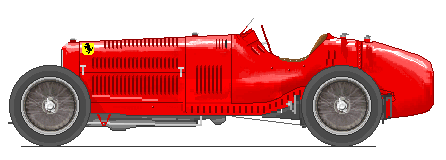 Rebuilt car for 1934 formula New car for 1934 formula 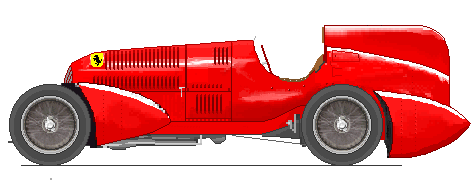 Stream Liner 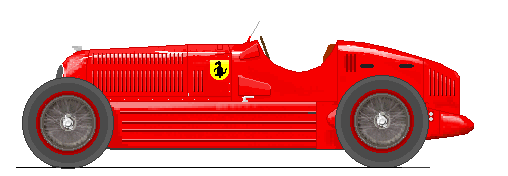 Formula Libre car 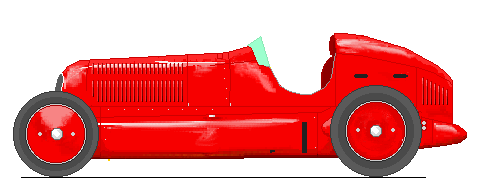 Speed Record Car Alfa Romeo Bi-motore
The Alfa Romeo Bi-motore were not real Alfa Romeos as the cars were produced by Scuderia Ferrari. Two cars were built, one to be raced by Chiron with two 2.9 litre engines and one car with two 3.2 litre engines for Nuvolari. The cars were based upon the Tipo B Alfas with the wheelbase lenghtened by 15 cm. The car used the same dual propeller shafts as the Monoposto and rear engine was installed back to front between the shafts. The driver seat was moved to the top of the gearbox and the fuel tanks to the side of the body. Special arrangements were made so the driver could disconnect the engines to start them before they where syncronized and it was also possible to run on one engine only. The cars were raced at the 1935 Tripoli and AVUS races and proved fast but very hard on the tyres. 16 June 1935 Nuvolari broke the class B land speed record on the Firenze-Lucca highway with his Bi-motore being the first to break the 200 mph barrier on a normal road. In 1937 the 5.8 litre car was raced in England by A Dobson . It was later sold to Peter Aitken and rebuilt and raced with the rear engine removed as the Alfa-Aitken. 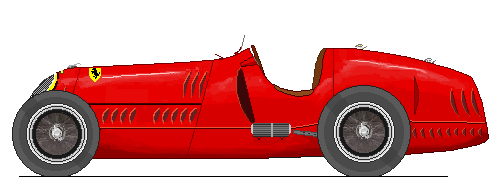 8C-35 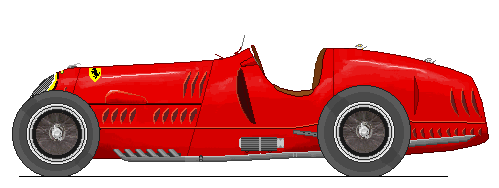 12C-36 (1936) 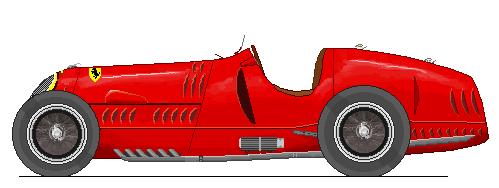 12C-36 (Monza 1936 onwards) Alfa Romeo 8C-35 / 12C-36
As a replacement for the Tipo B Alfa Romeo produced the 8C-35 in 1935. The car was also known as the Tipo C. Following the example set by the Germans the car had independent suspension and a streamlined body. With a volume of 3.8 litre the engine was the final development of the 8 cylinder engine used on the Monza and the Tipo B. For 1936 the car was equipped with a new 12 cylinder engine. Named the 12C-36 the new car differed from the old by the two exhaust pipes under the chassis, the 8C-35 having only one pipe on the right side of the body. The 12 cylinder car proved faster but more prone to engine troubles than the 8 cylinder. The 8C-35 made its debute at the 1935 Italian GP, Nuvolari leading for a while before retiring with a burst piston while the 12C-36 was first seen at Tripoli 1936. The 8C-35 found its way to a few privateers, Rüesch bought a 8C-35 in late 1936 followed by Sommer in 1937. While the factory Alfa Romeos in 1937 had no chance against the German teams in the GP races Rüesch entered his car successfully in some minor races. Rüesch sold the car in 1939 to Robert Arbuthnot in 1939 and it was raced after the war by Dennis Poore. Another car possibly entered by Ferrari for Farina in the 1936 Vanderbilt cup remained in USA and was rebuilt with a large centrifugal blower. It was endered for the 1937 Vanderbilt cup for Rex Mays. The car was later seen at Indianapolis. Right Side view:
Note the high exhaust on the right side of the 8C-35. Victories:
Indianapolis record:
 Alfa Romeo 12C-37
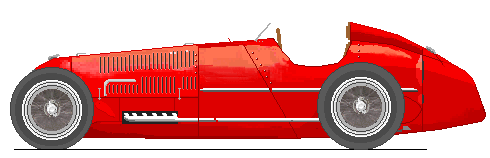
The 12C-37 was an experimental car. Constructed by Jano it featured an enlarged variant of the 12 cylinder engine in a completely new tubular chassis. The body was of a new lower and more streamlined type with the fuel carried in a saddle tank. With great fuss the car was entered by Alfa Corse for the 1937 Coppa Acerbo but the new car failed to make any impression during the race and when the chassis was found to be insufficiently strong Jano was blamed and sacked from Alfa Romeo. The chassis were probably used on the Tipo 312 / 316. 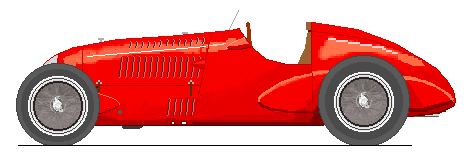
Alfa Romeo Tipo 308
Alfa Romeo entered the 3 litre formula with no less than three different cars, all with independent supension and distinct appearance. Many consider that the factory should have done better concentrating on just one car instead. The first one, the 308, was a development of Jano's classic 8 cylinder car. Finally the bore was increased from 68 to 69 mm changing the volume from 2905 to 2994 cc. Four old 8C-35/12C-36 tubular chassis were used with only minor updates. The car was rather a stop gap construction until the stronger 12 and 16 cyl cars were ready. Fuel was held in a saddle tank over the driver's feet to improve the weight distribution and handling. The car first appeared at Pau 1938 where a leak in the saddle tank caused the accident that made Nuvolari to resign from Alfa Romeo. Two of the cars were later borrowed(?) to Piero Dusio's Scuderia Torino and a third to Renato Balestrero. One car was raced to victory in the 1938 Rio de Janeiro GP by Pintacuda. It was then sold and remained in South America. There was also a car raced by Sommer in 1938 and (later?) sold to him, the sold car turning around the ban of foreign drivers. At the 1939 French GP two 308s were entered by Christian Kautz. The cars had Swiss crosses painted on the scuttle. One 308 car (AC 79), possibly ex-Pintacuda, was later shared by Landi and Casini before Landi sold it to Cassini in 1948. Late 1949, it was loaned to Antonio Fernandez who crashed it badly. Later (circa 1956) Casini rebuilt the car onto a road car, fitting a Cadillac engine. Later it went via Colin Crabbe? to Julian Mazjub. Another car (AC 78), owned by a Signor Bellini Caviglia, arrived at Montevideo late 1938. Dr. Italo de Luca bought it. Between 1939 and 1942, the car was raced by Ricardo Nasi, Ricardo Carú and José Canziani. In 1946, the car was bought by Oscar Galvez in partnership with Julio Rosso and Ernesto Petrini. It was successfully raced by Oscar Galvez between 1947 and 1951 before he sold it to "Automovil Club Argentino", which gave it to Fangio. It was raced by Manuel de Teffé in 1952. It is now shown at the J-M Fangio Museum. A third car was used by Sommer after the war on loan from Alfa Corce. It was also raced by Wimille and later own by "Raph", who probably sold it in Brazil 1948, It was raced in 1949 by Mr. Jaime Neves. Sommer's original pre war car appeared at the 1940 Indy 500 and it is probably the same car that also appeared in 1946-1948. Victories:
Indianapolis record:
A great thanks to Patrick Italiano and Jimmy Piget for cars/chassis information  Tipo 312 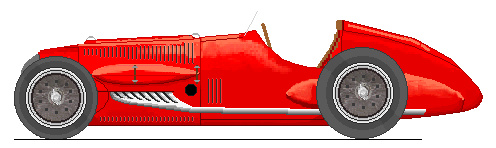 Tipo 316 - 1938 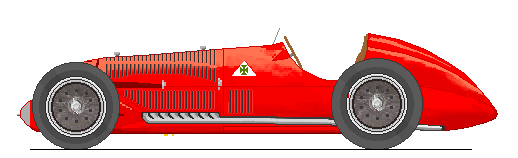 Tipo 316 - 1939 Alfa Romeo Tipo 312 / Tipo 316
The second car for the 3 litre formula was the 312. It was a development of the 12C-37, probably using the old frames, but it turned out to have much improved road holding. The engine, being a 3 litre variant of the V12 with twin superchargers, was stronger than the one on the 308 but still no match for competition. It first appeared at the 1938 Tripoli GP driven by Farina, Sommer and Siena. It proved to be a devastating race for the team as Siena had a fatal crash with his car and Farina was involved in a crash with Hartmann that proved fatal for the latter In 1947 Varzi was offered a 312 rebuilt with the original 12C-37 4.5 litre engine rebored to 4.6 litre and it was later taken to Argentina. The third car, the 316, was also a a development of the 12C-37 but featured a 16 cylinder engine, consisting of two 8 cylinder blocks put together in a 60° angle, each with its own crankshaft and supercharger. There was no room for the superchargers in front of the engine so they had to be squeezed in between the cylinder heads. The engine was put into a special 8C/35 / 308 car for the 1938 Tripoli GP where it showed promise during practice but did not fulfil its promises during the race. Development of the car was halted as the team concentrated on the 1.5 litre "Alfetta" and the 316 wasn't seen until the Italian GP where it finished second. At the 1939 Belgian GP the car, raced by Farina, featured a new distintive "dolphin head" style nose. It held the lead during the first laps before being passed eventually to retire with supercharger failure. 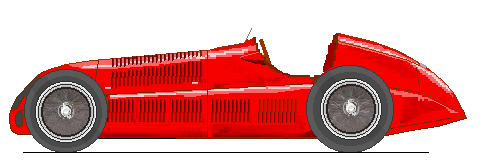 1938 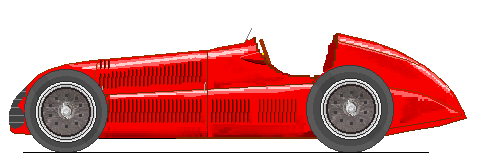 Post Tripoli 1939 Alfa Romeo T158 "Alfetta"
During the spring of 1937 Alfa Romeo decided, after a suggestion from Ferrari, to design a competitive Voiturette car. However, as Jano was busy with the construction of the three GP cars, the mission fell to Giocchino Colombo. Constructed as miniatures of the 308 GP car the neatly built Alfettas were assembled at Ferrari, Modena, under the supervision of Enzo Ferrari. Then, in January 1938, the decision was made to retrieve Alfa Corse and close down Scuderia Ferrari. The half finished cars were moved to Portello to be finished there. The cars made their debut in the Coppa Ciano Junior in August 1938 where they took a 1-2 victory first time out. After trouble in the Coppa Acerbo Junior the team then decided to skip both the Berne and Lucca races, concentrating to get the cars right for the Milano GP at Monza, where Villoresi led the team to another 1-2 victory. However, at Modena the team was again in serious trouble, all four cars retiring with oil pressure problems. The cars were updated for the 1939 season with improved lubrication and needle-roller big ends. However, after the defeat in the Tripoli race three cars were rebuilt again with reworked lubrication once more and with an improved engine cooling by raising the system pressure. The cars were re-bodied with a more bulbous form that also covered the front suspension. In that form the cars won the Coppa Acerbo, Coppa Ciano and the voiturette class of the Swiss GP, Farina showing the potential of the cars by leading the initial laps of the latter in front of the GP cars. In June 1939 Emilio Villoresi died in a car demonstration and only 53 days later Nando Aldrigretti was killed during practice for the 1939 Coppa Acerbo. For 1940 Alfa Romeo decided to build six (See below) new 158 chassis. The old ones including the wrecked cars from Aldrigretti and Villoresi seem to have been chopped up and used to build the six new ones. After dominating the 1940 Tripoli race the cars were stored at Monza. One car was fitted with suspension from the 512 and crashed with a lorry while being tested at the Milan-Varese autostrada by Marinoni. Later when Monza was taken over by the German army, the cars were moved in the greatest secrecy to a deserted cheese factory in Melzo in dismantled form. The cars reappeared after the war, making their debut in St.Clowd 1946. Two cars appeared with two stage compressors at the following race at Geneve and at Turin all four cars had two stage compressors. One car was later further improved to was known as "C" with larger compressor and larger fuel tank. Varzi had a fatal crash with that car at the 1948 Swiss GP. All the cars were upgraded for the 1950 season, the cars dominating the season with Farina claiming the World Championship and for 1951 four totally new cars called 159s were built with larger tanks and increased horsepower. After Fangio had won the 1951 championship Alfa Corse retired from racing. Most of the 158/159s were cut up and destroyed. * The Alfa Romeo 158 chassis remains one of the most unsolvable problems in motor racing history. The first 6 cars seems to have had their own chassis numbers but cars were disassembled and assembled so often that parts became mixed up. The latter chassis had no own chassis numbers, cars receiving new numbers for each race corresponding to race numbers. One of the six new cars built for 1940 was totally wrecked and burned out in Marinoni's crash. Still 6 cars remained after the war. How? Victories:
Variants: 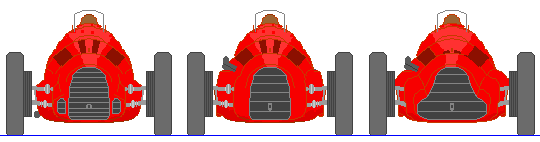 1938 Tripoli 1939 Post Tripoli 1939 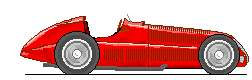 1938 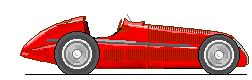 Tripoli 1939 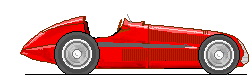 Post Tripoli 1939 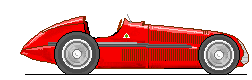 Postwar 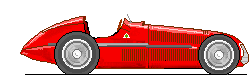 Spec 1947 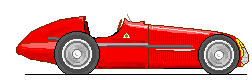 T159 1951 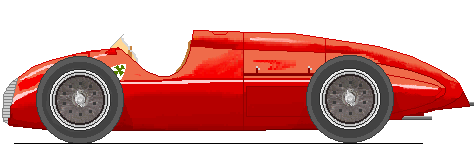 Alfa Romeo Tipo 512
This mid engined car was intendent as a replacement for the Alfa Romeo 158. The engine was of "boxer" type i.e. 180°. It was tested on 12 September 1940 by Consalvo Sanesi. The developement was then stopped due to the war. It never took part in any competition. MORE CARS CAR INDEX Back to Contents
| ||||||||||||||||||||||||||||||||||||||||||||||||||||||||||||||||||||||||||||||||||||||||||||||||||||||||||||||||||||||||||||||||||||||||||||||||||||||||||||||||||||||||||||||||||||||||||||||||||||||||||||||||||||||||||||||||||||||||||||||||||||||||||||||||||||||||||||||||||||||||||||||||||||||||||||||||||||||||||||||||||||||||||||||||||||||||||||||||||||||||||||||||||||||||||||||||||||||||||||||||||||||||||||||||||||||||||||||||||||||||||||||||||||||||||||||||||||||||||||||||||||||||||||||||||||||||||||||||||||||||||||||||||||||||||||||||||||||||||||||||||||||||||||||||||||||||||||||||||||||